Wednesday, April 27, 2011

TALIBAN'S NEW SURPISE ATTACK?


Taliban prisoner, Kandahar, Afghanistan, 2007. Photo by Sasha Uzunov.

TALIBAN'S NEW SURPISE ATTACK?

by Sasha Uzunov

Could the recent mass break out of Taliban inmates from Kandahar prison in southern Afghanistan using a tunnel be a sign of something more sinister
and deadly to come? That is surprise attacks on NATO bases, causing many casualties.

The Guardian newspaper, UK, revealed in a report by Jon Boone, 25 April
2011 that:

"Afghan and Nato forces have launched a huge operation to try to recapture 475 prisoners, nearly all of them Taliban insurgents, who staged an
extraordinary mass prison breakout using a tunnel.

" Officials said the inmates had escaped through the tunnel, dug from a
house to the wing of the prison where political prisoners are detained in
Kandahar.

"In an email, Zabiullah Mujahid, a Taliban spokesman, said the tunnel was
1,050ft (320 metres) long and had taken five months to construct,
"bypassing enemy check posts and Kandahar-Kabul main highway leading
directly to the political prison".

"He said just three insurgents inside the prison had known about the plot.
They helped ferry the prisoners out of the jail in an operation lasting four
and a half hours."

If the Taliban can come and go as they like in and out of jail, what is to stop them from having a suicide team tunneling into a NATO base and causing
carnage as well as political embarrassment to NATO?

Canadian military expert Scott Taylor makes the following point about the
Kandahar NATO airfield:

"If they can tunnel into the prison, they could tunnel under the airfield
security fences as well.....As you know, all 27,000 NATO troops inside the
wire carry a weapon, but NONE of them carry live ammunition (only the
perimeter guards are fully armed)....a single Taliban suicide squad could do a lot of damage if they tunneled in..."

(end)

Obtain your DVD copy of TIMOR TOUR OF DUTY

go to the film link at:

http://timortourofduty.blogspot.com/


Sunday, April 24, 2011

ANZAC DAY 2011 -Leslie Farren 5RAR


ANZAC DAY 2011 - This year will mark the 45th anniversary of the first National Serviceman / conscript from the state of Victoria, Australia to be killed in the Vietnam War on 10 June 1966...His name is Leslie Thomas Farren of Reservoir. Read his story.

He was killed 19 days short of his 21st Birthday by a Viet Cong mortar barrage.

A memorial plaque was unveiled in 2006, honouring Private Farren's sacrifice. The story was covered by the Herald Sun newspaper, the Preston Leader newspaper and Channel 9 news Melbourne (17 August 2006 by reporter Wayne Dyer) and Channel 7 news Melbourne (28 August 2006).

His 86 year old mother Lillian Farren was on hand to unveil the plaque. Sadly she passed away a few years ago.

Dr Frank Donovan, a well respected psychologist, author, former Western Australian Member of Parliament (ALP) was an Army medic in Vietnam and he nursed Private Farren during his last moments.

Mr Frank Donovan, 10 Platoon, D Coy Corporal Medic, the man who held Pte Les Farren as he died and uttered his last words...

"Don't let me die doc, don't let me die,"
he (Les) whispered.

source: 5RAR Association website: www.5rar.asn.au/tributes/farre
n_plaque.htm


A First Angry Shot Remembered

(The Melbourne Herald Sun, page 20)
by Sasha Uzunov
August 24, 2006 12:00am


Bank teller Les Farren did not live to hear Prime Minister John Howard's apology for the reception his mates received from a disillusioned public when they returned home from Vietnam.

This little-known soldier from the Melbourne suburb of Reservoir was the first Victorian National Serviceman to die in that controversial war.
But he will be remembered when his 86-year-old mother, Lillian Farren, unveils a plaque on Monday at the Reservoir Cenotaph.

Forty years after his death, Mrs Farren still grieves for her son. "It was awful to see Les go and never see him again", said Mrs Farren. This way he will be remembered."

Les was always in the shadow of another Melbourne suburbs boy when he went to Vietnam. The 1960s Australian pop legend, Normie Rowe, was one of his schoolmates at the Northcote High School before they were called up for Vietnam.

Les, two years older than Normie, was quietly spoken and looking forward to being an accountant in the suburbs. Normie, in the era of Beatlemania, was being mobbed by screaming hysterical teenage girls and had the music world at his feet.

But Vietnam changed their lives. Pte Leslie Thomas Farren was conscripted in 1965 and posted to 10 Platoon, Delta Company, 5th Battalion, the Royal Australian Regiment, Infantry Corps.

He was also a keen amateur photographer and the only son of Thomas and Lillian Farren.

On June 10, 1966, while on patrol in South Vietnam, Pte Farren was severely wounded by Viet Cong mortar fire. He was 19 days short of his 21st birthday. Cpl Frank Donovan was the army medic who tried to help Les.

"Les Farren actually died in my arms from massive lower body wounds," said Cpl Donovan. The extent of his wounds and loss of blood made survival impossible.

Trooper Norman J. Rowe got the call up in 1968 and went to Vietnam in 1969 with A Squadron, 3rd Cavalry Regiment, Armoured Corps.
He survived but it almost ended his musical career.

I took an interest in Les Farren after reading about him in a newspaper more than 15 years ago. I was surprised no one had acknowledged his service. Les was one of the unsung people who do their duty without fuss or fanfare.

Len Barlow, secretary of the Victorian branch of the Vietnam Veterans Association of Australia helped me to lobby Darebin Council for the commemorative plaque that will be unveiled by his mother.
To its credit, the council quickly approved the proposal.

Les Farren has not been forgotten but it has taken too long to acknowledge his service.

Following the Prime Minister's words on Vietnam Veterans Day last Friday, the sacrifice of these veterans' might now be better remembered.


Memorial Plaque Ceremony for Private Leslie Farren (10 Platoon, D Company, 5 RAR) First Victorian National Serviceman to be killed in Vietnam War on 10 June 1966.

MONDAY 28 August 2006, Reservoir Cenotaph, Reservoir, City of Darebin, Victoria.

VIDEO HIGHLIGHT

Mr Bob Elworthy, President of the Victorian Branch, Vietnam Veterans Association of Australia, speaking at the commemorative plaque ceremony for the first Victorian National Serviceman to be killed in Vietnam, Private Leslie T. Farren, D Company, 5 RAR. Date: 28 August 2006, marking the 40th anniversary of his death on 10 June 1966. Reservoir (City of Darebin), Melbourne, Victoria, Australia.

Part of Mr Elworthy's moving speech:

Leslie Farren ... for he was young once and he was a soldier. Vietnam was his time and he did his duty ...
Lest We Forget.

(View the video clip Here- 1.2Mb).

Mr Frank Donovan, 10 Platoon, D Coy Corporal Medic, the man who held Pte Les Farren as he died and uttered his last words...


"Don't let me die doc, don't let me die," he (Les) whispered.
(View the video clip Here- 920Kb).

Bob Elworth President of the VVAA-Vic talking to 5RAR veterans'

Mr Frank Donovan who was the medic assisting Pte Farren

Pte Leslie Farren's mother at the dedication ceremony
Councillor Stanly Chiang Lays a wreath at the ceremony
The commemoration plaque to Private Leslie Farren

Sasha Usinov with the Plaque

Saturday, April 23, 2011

The Politics of Procurement


www.cpac.ca/forms/index.asp?dsp=template&act=view3&template_id=1418&hl=e

Canadian journalist Scott Taylor's new doco about the F-35 fighter jet: The Politics of Procurement

Canada needs a new fleet of fighter jets to replace the decades’ old CF-18s, but which aircraft at what cost? The government has already decided that the F-35 Joint Strike Fighter is the only one that can meet the military’s needs. The opposition is fighting the purchase because it's being made without a competition from aircraft makers. When completed the acquisition will be the largest military equipment purchase in Canadian history. Respected military journalist Scott Taylor will hear from all sides of the debate and gets exclusive access to some of the most advanced aerial fighter machines on the planet as he examines F-35: The Politics of Procurement.
SCOTT TAYLOR LOOKS AT THE F-35 To buy or not to buy? For Canadian defence, this has been key procurement question over the past year. And it’s caused a political firestorm on Parliament Hill and along the campaign trail.

AUSTRALIAN WOMEN IN COMBAT

The story TEAM UZUNOV reported 2 years ago, now back in the news...

AUSTRALIAN WOMEN IN COMBAT

There are those who strongly oppose it. Both sides present strong arguments. Women in combat will probably become a reality more by default than by a political commitment to equal opportunity or grandstanding.

http://teamuzunovmedia.blogspot.com/2009/09/australian-women-in-combat.html

read on...

Thursday, April 14, 2011

RONALD REAGAN'S FOREIGN POLICY

Ronald Reagan, 40th President of the United States of America, 1981-89

Was Reagan's policy of taking a gun to a gunfight the right one after all?

On Line Opinion: Australia's e-journal of social and political debate.

www.onlineopinion.com.au/view.asp?article=11872&page=0

Was Reagan right?

By Sasha Uzunov - posted Thursday, 7 April 2011

As a teenager growing up in 1980s Australia, my generation was constantly bombarded by the media that the world was destined for nuclear holocaust because of the Cold War showdown between the United States and the Soviet Bloc. The then US President Ronald Reagan, a former B-grade Hollywood actor, was painted as a loopy politician who could not differentiate between reality and an old film script.

But with hindsight, was the 40th President of the United States (1981-89) correct in his handling of world events, namely the dismantling of Communism and confronting Middle East and North African “mad dog” leaders?

Teddy Roosevelt, US President from 1901-09, believed in “speak softly and carry a big stick” in foreign policy. But could we summarise Reagan’s doctrine as “speak loudly and carry a medium sized stick?”

Some have credited Reagan with “winning” the Cold War (1947-89) by draining the Soviet Union’s resources with his elaborate but science fiction Strategic Defence Initiative (SDI), commonly known as “Star Wars.” Star Wars would see the US use satellites to block Soviet Nuclear missiles from hitting the US. In order to counter Star Wars the Soviets would have to spend billions in acquiring the technology.

In a 1983 speech with Biblical overtones, Reagan preached:

So, in your discussions of the nuclear freeze proposals, I urge you to beware the temptation of pride - the temptation of blithely declaring yourselves above it all and label both sides equally at fault, to ignore the facts of history and the aggressive impulses of an evil empire, to simply call the arms race a giant misunderstanding and thereby remove yourself from the struggle between right and wrong and good and evil.

Moreover, Reagan supported covert aid to Islamic resistance fighters or Holy War warriors (mujahaddin) in Afghanistan, which was invaded by the Soviets in 1979. The Soviet’s Afghan War lasted nearly a decade and finally ended when the reform minded Mikhail Gorbachev pulled the plug on a disastrous intervention.

The downside of US support to the mujahaddin was the inadvertent growth of Al Qaeda, now fighting a war by terror against Washington. America as well as its two allies, Saudi Arabia and Pakistan, provided money, training and weapons to those groups whom later evolved into Al Qaeda.

Reagan came unto the political scene when an America was perceived as being impotent on the foreign stage, after the debacle of the Vietnam War (1962-72), the 1979 kidnapping of US diplomats in Iran during the Shiite Islamic revolution led by cleric the Ayatollah Khomeini, which overthrew the Shah, and the subsequent but failed US military attempt to save the diplomats.

To shake off the Vietnam syndrome, Reagan authorised the military invasion of neighbouring Caribbean island of Grenada in October 1983 to overthrow a ‘Marxist’ government aligned with arch nemesis Cuba, an ally of the Soviet Union.

No doubt the former actor would have appreciated how this was reflected in popular culture at the time. In a 1987 war movie, Heartbreak Ridge, Clint Eastwood plays US Marine Gunnery Sergeant Highway, who bemoans the fact he has a 0-1-1 record. That is one draw in Korea and a loss in Vietnam and would want to retire with one victory, Grenada, under his belt.

Days before Grenada, the President’s act tough foreign policy backfired when 241 US Marines were killed by a suicide bomber in Beirut, Lebanon. Despite pledging to stay on, Reagan later withdrew the troops. The spectre of body bags from an earlier Southeast Asian war would have played on his mind.

Pulitzer prize winning American journalist Steve Coll, in his book Ghost Wars, reveals that Ramzi Yousef, an Islamist terrorist, had “come to the conclusion that only extreme acts could change the minds of people and the policies of nations. He cited as one example the suicide bombing of the US Marine barracks in Lebanon.”

But behind the sledgehammer approach, Reagan had a subtle, cunning plan, bordering on the illegal. During his Presidency, the Ayatollah’s Iran and the Soviet Union were regarded as America’s main enemies.

So much so, that this, once again, permeated popular culture of the time. The World Wrestling Federation (WWF), professional wrestling shown on American and international television had an enormous following in the mid 1980s. To reflect the political currents, two bad guy characters appeared: The Iron Sheik and Nikolai “The Bolshevik” Volkov. The Iron Sheik wore traditional Persian pants and shoes and would wave the Iranian flag as he came to the ring. He would shout to the hostile crowd “Iran number one, America, haaak p-too (simulate spitting). “

Volkov would wave the Soviet communist flag of hammer and sickle and then sing the Soviet national anthem. Eventually, both bad guys would get their comeuppance when a “Corporal Kirchner” a Vietnam veteran would defeat them in the wrestling ring during pure ideological theatre.

But Reagan saw through the good guy, bad guy rhetoric. From 1980 to 88, the US gave covert aid to Saddam Hussein’s Iraq as it waged a war with neighbouring Iran. In 1986, the Iran-Contra scandal came to light, when two US officials close to the White House, Lieutenant Colonel Oliver North and Admiral John Poindexter, were caught illegally selling arms to arch enemy Iran and using the proceeds to fund a covert war in central America. However, no direct link was ever established to Reagan and North and Poindexter’s subsequent criminal convictions were later overturned on appeal.

In the current crisis affecting Libya, the dictator Colonel Muammar Qaddafi is ruthlessly trying to put down a popular rebellion. Both the US and its allies have launched air strikes against the Qaddafi regime. At one time the Libyan strongman was a darling of the radical left in the west. But now is seen as a bad guy by these very same elements.

However back in 1986 in response to Libyan sponsored terrorism against US targets, Reagan bombed Qaddafi. Heexplained:

'Colonel Qaddafi is not only an enemy of the United States, his record of subversion and aggression against the neighboring states in Africa is well documented and well known. There is no security, no safety in the appeasement of evil.

'This mad dog of the Middle East has a goal of a world revolution... I find he's not only a barbarian, but he's flaky.'

Reagan’s doctrine of “talk loudly and carry a medium sized stick” was with hindsight the correct course of action in an imperfect world. Bearing in mind he had to shake off the shackles of Vietnam, avoid nuclear holocaust with the Soviets and navigate unchartered waters to deal with middle-east terrorism.

(end)

Tuesday, January 25, 2011

MELBOURNE AIRPORT SECURITY CONCERN


MELBOURNE AIRPORT SECURITY CONCERN. Photo by Sasha Uzunov, copyright 2011.


TEAM UZUNOV INVESTIGATION.

In light of the recent terror attack on Moscow Airport, Russia, you would think that Melbourne Airport authorities would enforce their own security measures...But over the past couple of months, motorists, to avoid expensive parking at Melbourne Airport, (Victoria state, Australia) or to simply watch aeroplanes fly over, have been parking in the emergency stopping lane or roadside on the Tullamarine Freeway, about 1 to 2 kilometres from the Airport entrance.

By law this is forbidden, as the above photograph demonstrates. Photograph taken on Monday evening, 24 January 2011.

Drivers may not necessarily pose a direct security threat or even be members of Al Qaeda !

Heaven forbid should any attack happen but should an incident arise then the potential is there for clogging the freeway or simply creating an obstacle for emergency response teams.

No regular security or police patrols have been observed in keeping the emergency stopping lanes clear on the Tullamarine Freeway. Perhaps, Melbourne Airport officials should lower the expensive parking fees to get motorists off the freeway.

link:

www.abc.net.au/news/stories/2011/01/25/3120757.htm
ABC News - 25 January 2011

Carnage as bomber targets Moscow airport

Sunday, January 16, 2011

BEATING WIKILEAKS TO THE PUNCH ON AFGHANISTAN


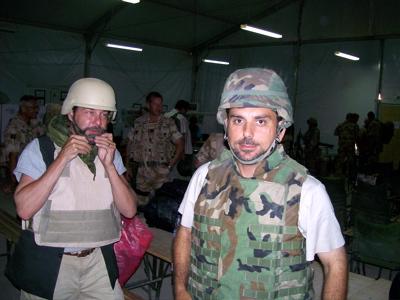
Canadian reporter Scott Taylor (left) and Sasha Uzunov (right) in Kandahar, Afghanistan to film a documentary in 2007 for Canadian television. Uzunov does a Jim Waley impersonation by donning a flak jacket and helmet.


It has has taken The Sunday Age's (Fairfax newspapers) self-appointed
defence expert, Tom Hyland, three years to reveal, courtesy of wikileaks,
what TEAM UZUNOV reported back in 2007 about Australia's mission in
Afghanistan, in particular the difficult relationship with our ally the Dutch.

Here's Hyland's story:

www.smh.com.au/technology/technology-news/bickering-warriors-in-coalition-of-unwilling-20101225-197es.html

Bickering warriors in coalition of unwilling

December 26, 2010

Mistrust, indecision and hostility undermined Australia's alliance with the Dutch and Americans in what was supposed to be a united front against the Taliban and in restoring stability to Afghanistan, writes Tom Hyland.

We squabbled with our allies, yet in public we talked of close co-operation. We frustrated the Americans with unfulfilled promises. Our politicians big-noted in public, but dithered in private.

Our bamboozled bureaucrats tried to make sense of the details. All along, the public was kept in the dark. Thanks to WikiLeaks, we now have an insight into the diplomatic and political skirmishes behind the war in Afghanistan, now in its ninth year and which has cost 21 Australian lives.

Cables from 2007 reveal intense distrust between Australian and Dutch forces in Oruzgan province, where Australia was part of a Netherlands-led force....


In February 2007, Australian officers, concerned that the Taliban were preparing a do-or-die offensive, started planning to send special forces back to Oruzgan.
This was just five months after the Howard government pulled them out, in September 2006, when it argued Oruzgan was ''relatively stable''.
The government and defence chiefs defended the withdrawal at the time, saying Australian reconstruction troops remaining in the province were well-protected, with their own forces and 1400 Dutch soldiers.
But their claims of stability and their stated faith in the Dutch were undermined by early 2007, when intelligence reports warned of a Taliban resurgence....

http://newmatilda.com/2007/06/06/news-front
AFGHANISTAN
6 Jun 2007

News from the Front

Australian journalist Sasha Uzunov reports from the Afghan front
The Forgotten War
Sometimes it takes an outsider to tell us the most uncomfortable truths.
Last week, Defence Minister Dr Brendan Nelson took a swipe at critics who question the pace at which Australian troops are securing their designated province in Afghanistan, saying:
Any suggestion Australian troops are not pulling their weight in southern Afghanistan is beneath contempt. Australia is steadfastly committed to Uruzgan as shown by the recent decision to deploy a Special Operations Task Group of approximately 300 people to the region.
However, the recent decision to send Special Forces back to Uruzgan could also be read as a tacit admission that not all is well with the mission. (Who was the genius who decided to remove our Special Forces soldiers from Afghanistan late last year?)
When I asked the Defence Minister if a rift had developed between Australian troops and the Dutch Army engineers they are serving alongside, over who was doing the most to secure Uruzgan, Nelson would not comment.
The controversy was sparked by prominent German journalist, Ulrich Ladurner, who claimed, in an interview he gave to me at Kabul airport on 14 May, that both the Australians and Dutch were being slow in establishing security in the province.
read more at
http://newmatilda.com/2007/06/06/news-front

Tom Hyland's Fairfax colleague, Suzanne Carbone, had the courtesy to give credit where credit is due.

Perhaps Hyland should realise that Australia's Defence debate is not the preserve of "experts" but belongs to the Australian taxpayer who has to pick up the tab.


http://teamuzunovmedia.blogspot.com/2009/03/holding-peacemakercircuit-breaker.html


Friday, January 30, 2009 - TEAM UZUNOV

MINISTER ON AFGHAN FACT FINDING TRIP?
ExclusiveTim Holding - Brumby’s man turned PM Rudd’s international man of mystery?

VIC MINISTER WON’T CONFIRM OR DENY AFGHAN TRIP

By Sasha Uzunov
Copyright 2009

Mr Tim Holding, a Victorian State government minister who is a former Australian Army Reserve Special Forces soldier, will not confirm nor deny speculation about him undertaking a short fact finding mission to Afghanistan on behalf of Prime Minister Kevin Rudd.

A prominent strategic analyst, who has the close ear of governments, and speaking on the condition of anonymity, said he wanted to “float the idea of Mr Holding undertaking a fact finding mission to the Australian base in Tarin Kowt province [in Southern Afghanistan].”

“Mr Holding is an intelligent young politician with links to Special Forces. The Australian media underestimate his ability, which is why he would be ideal for the mission: he would slip under the media radar,” the strategic analyst said. “Mr Holding has not been informed of the proposed trip.”

The analyst said Prime Minister Kevin Rudd was not happy with the flow of information about Afghanistan coming from the army chain of command and needed his own “eyes and ears” on the ground for a couple of weeks to assess the situation.

Mr Holding’s office was contacted a week ago to confirm or deny if Mr Holding knew the speculation about the Afghanistan trip. But no comment has been forthcoming.Mr Holding served as a Signaller or communications expert with the elite Army Reserve Special Forces unit, 126 Commando Signals Squadron, then attached to 1 Commando Regiment, 2nd Company, at Fort Gellibrand, Williamstown, Melbourne, Victoria from 1991 to 1993.

Greg Sher the eighth and most recent Australian soldier killed in Afghanistan was also a member of 1 Commando Regiment (1 CDO Regt).Mr Holding is the Minister for Finance, WorkCover and Transport Accident Commission, and Minister for Water, Minister for Tourism and Major Events in the John Brumby ALP state government.

A former Australian intelligence agent, with extensive Middle East experience, and also speaking on the condition of anonymity, said he believed that Prime Minister Rudd would change Australia’s current military policy and commit a regular army infantry battalion (about 500 soldiers) to Afghanistan very soon.

Current military policy is for Australia’s Special Forces units, SASR and 4RAR (Commando) to do the frontline fighting in Afghanistan, which according to standard doctrine should be carried out by regular infantry.

SASR and 4RAR (Cdo)’s traditional roles include surveillance of the enemy, information gathering or carrying out raids against targets or securing entry and exits points for other army units.

SASR, 4RAR (Cdo) and 1 CDO Regt fall under the Australian Army's Special Operations Command (SOCOMD).

In contrast the Canadian army, after decades of peacekeeping, has regular infantry fighting the Taliban in the dangerous southern Afghanistan province of Kandahar. But over 100 Canadian soldiers have been killed.

(end)

-----------------------------------------------------------------

The Age, Diary Column, Tuesday, 3 February 2009.

Timmy, don't forget to pack the water canteen
by SUZANNE CARBONE

TIM Holding was dubbed "Twinkle Twinkle" because he was considered a little star, and he's really made an impact in the water portfolio with those faulty four-minute shower timers that last for 40 minutes or four hours. But Dim's moment to shine may have arrived.

Former Australian soldier Sasha Uzunov, now a photo-journalist, writes in his blog that Holding (below) could be destined for Afghanistan as Kevin Rudd's "eyes and ears" on the ground. You see, Holding is well credentialed as a former member of the Army Reserve in the 1st Commando Regiment - and he's Tourism Minister.

A "prominent Canberra strategic analyst" told Uzunov: "Mr Holding is an intelligent young politician with links to special forces. The Australian media underestimate his ability, which is why he would be ideal for the mission: he would slip under the media radar."

The analyst claimed the PM was not happy with the flow of information from Afghanistan so the analyst would suggest Holding embark on a "fact-finding mission" to the Australian base in Tarin Kowt. Diary asked Commando Holding about swapping a fluoro vest for a flak jacket, and he said:

"While I will sit by my phone awaiting the Prime Minister's call, I will make it clear to him that I will only travel to Afghanistan in the company of my friends at The Age Diary."

Who knew Twinkle had a sense of humour? We'll only go if he acts as our human shield. And brings a shower timer that works.

(end)

-------------------------------------

Canadian film on Afghanistan

View the complete film at this link:
www.cpac.ca/forms/index.asp?dsp=template&act=view3&pagetype=vod&hl=e&clipID=4759

Canadian documentary film, "Afghanistan: outside the wire," 60 minutes long, camerawork by Scott Taylor (host/producer), David Pugliese and Sasha Uzunov.

CPAC Special
"Afghanistan: Outside the Wire"