Monday, April 11, 2016

MODERN HISTORY WARS - Macedonia

THE HISTORY WARS IN MACEDONIA - SOFIA-BELGRADE AXIS
- by Sasha Uzunov


TEAM UZUNOV INTERVIEW WITH DR JOHN SCHINDLER - author of The Fall of the Double Headed Eagle - a history about World War I.
- Gavrlio Princip - assassin of Austrian Archduke Franz Ferdinand in Sarajevo 1914, triggered World War I. -


-------
1. Dr Schindler, tells us about your book The Fall of the Double Headed Eagle? You uncover some incredible material...
A: The book is the product of years of research in archives and libraries -- a lot of the archival records especially in Vienna had lain undisturbed for a century. The story here was substantially untold, so I wanted to tell it and tell it right.

2. Are you aware that there are some historians in the Balkans, in particular Macedonia who should know better, who still paint Gavrilo Princip in a positive light, even though the ideology behind him, was anti Macedonian to say the least?
A: Princip remains a hero figure to many Serbs. Witness the statues of him still going up in Serbia and in Republika Srpska, a century later. To me, this is hardly a sign of political health.
3. Why do you think there has been such a whitewash of Princip in certain quarters? He became a mini cult in Tito's Yugoslavia despite the Serb nationalist overtones.
A: Titoism was happy to embrace a Yugoslav version of Princip; Serbian nationalists have their own version of him. In truth, he was an angry teenager brimming with hate and incoherent ideologies. He was much like jihadists today -- long on hate, short on thought, easy to manipulate.
4. Tell us about the mastermind behind Princip's assassination of Archduke Franz Ferdinand, the ruthless Colonel Apis?
A: Dragutin Dimitrijevic-Apis, the colonel who headed Serbian military intelligence, was the real driver of the Sarajevo assassination plot, there's no doubt about that, despite Belgrade's efforts to destroy paperwork to hide their official involvement in the crime. Apis was obsessed with Austria-Hungary and the Habsburgs, he got the war he wanted, though he did not survive it, being executed by his own government in 1917 for alleged treason (in reality the charges were trumped up, Apis was a political liability the Serbian military and the Karadjordjevic dynasty wanted to be rid of).  
5. The start of World War I gets pinned on Austria, but what of Russia and Serbia's role?
A: Austria bears a large amount of the blame, to be sure. Vienna, especially its top generals, itched for war against Serbia. For them, the assassination was a long-awaited pretext. But Russia bears huge blame too, not least because their military attache in Belgrade, Colonel Viktor Artamonov, was funding Apis's clandestine plots, including the Sarajevo assassination. We still don't know how much the Russian government knew about Artamonov's role but that he played a large one -- Apis admitted it -- is not in doubt. And of course Serbia bears enormous blame, its spies having trained, equipped, and dispatched the assassins into Bosnia to commit acts of terrorism. Belgrade has a lot to answer for here.
--------
- Who is Dr John Schindler?
John R. Schindler is a strategist, author, and commentator whose security-focused career has included a couple decades as both a scholar and practitioner. He is the national security columnist for the New York Observer.
Previously a professor of national security affairs at the U.S. Naval War College, where he taught courses on security, strategy, intelligence, terrorism, and military history, before joining the NWC faculty, he spent nearly a decade with the super-secret National Security Agency as an intelligence analyst and counterintelligence officer. There’s not much he can say about that, except that he worked problems in Eastern Europe and the Middle East with a counterespionage flavor, and he collaborated closely with other government agencies who would probably prefer he didn’t mention them. He’s also served as an officer specializing in cryptology (now called information warfare for no particular reason) in the U.S. Navy Reserve.
He’s been a a senior fellow of the International History Institute at Boston University and as well as the chairman of the Partnership for Peace Consortium‘s Combating Terrorism Working Group, a unique body which brings together scholars and practitioners from more than two dozen countries across Eurasia to tackle problems of terrorism, extremism, and political violence. He has lectured on terrorism and security in over twenty countries.
He is a historian by background, with a B.A. and M.A. from the University of Massachusetts and a Ph.D. from McMaster University. His books deal with topics like the Italian front in World War I, Islamist extremism in the Balkans, and an insider’s look at how Al-Qa’ida thinks and operates. His most recent book is on the beginning of World War I on the Eastern Front.

- HISTORY WARS IN MACEDONIA?

Todor Alexandrov -photo left -(-1924 )- set up his 1919 version of VMRO (Internal Macedonian Revolutionary Organization) with funds from Italy and later became a pawn in Italian fascist leader Benito Mussolini’s machinations during the 1920s before his assassination at the hands of rival Vancho Mihailov. It remains puzzling why he has been rehabilitated in Macedonia?

SOFIA - BELGRADE AXIS: What's wrong with Macedonian historiography?
We've had to endure the malicious influence of the late Dr Zoran Todorovski, the Director of the Macedonian state archive, and his kooky obsessive desire of turning a pro Bulgarian historical character, Todor Alexandrov (-1924), into a Macedonian hero. His powerful patron was Prime Minister Nikola Gruevski who also has a fascination with Macedonian historical figures whose pedigree is questionable. see link. The paradox is that Gruevski gives succour to controversial figures which is at odds with his support for the Holocaust Museum in Skopje, the capital of Macedonia.


VMRO-DPMNE’s leader Nikola Gruevski’s burning passion for Todor Alexandrov - see link 


CASUALTY - Has been eminent Macedonian historian Dr Todor Chepreganov, a critic of Alexandrov. The historian has been deliberately sidelined by the Gruevski government.
BULGARIAN nationalists today are eager for Macedonians to give up their legacy, of the World War II Partizan Resistance movement, because by doing so it absolves Bulgaria of certain nasty episodes in its history that it refuses to come to terms with, such as its role in the Holocaust.
There are naive people in Macedonia who have fallen for simplistic labels of levica / desnica (left and right wing), ignoring the fact that partizan Resistance movement was an unofficial alliance of Macedonian communists and nationalists fighting against Nazi and Bulgarian occupation during World War II.

The Macedonian Partizan Resistance movement (right) during World War II was an unofficial alliance of Macedonian communists and nationalists grouped together in the National Liberation Army of Macedonia (NOV na M), and fought against Nazi Germany and its allies Fascist Italy and the Kingdom of Bulgaria. 

It was only later after the war had been won that some pro-Belgrade Macedonians communists, acting on orders from Marshal Tito, turned on their own independent minded communist comrades and also nationalist allies and started locking them up, including a hugely popular Resistance leader Metodija Andonov Cento, who was the victim of Stalinist political show trial in 1946.


“...fought for the liberation of their [Macedonia] nation rather than for any communist ideology…”

link

link
-----------------------------------
Belgrade-Sarajevo-Skopje?

Macedonia became independent in 1991 - but there seems to be this obsession of placing it still within a Yugoslavist narrative, even though Yugoslavia has ceased to exist, and as prominent Serbian Human Rights Activist Sonja Biserko explained in her ground breaking book (link) ended up being used as vehicle for Serbian nationalism.

2014 - THE YUGOSLAVIST NARRATIVE CONTINUES - minus Slovenia! - Balkan Insight story by Sasha Uzunov 


GAVRILO PRINCIP ? Interpreting History in Macedonia.

BALKAN Insight Reporter Sinisa Jakov Marusic, a staunch critic of alleged Macedonian "ultra nationalism" has this quaint fascination with Serbian nationalist figures… He seems to have this obsession with apportioning blame on a mythical creature, the alleged “ultra Macedonian nationalist” for the ethnic tensions between Macedonians and Albanians when it has more to do with Serbian cultural hegemony via Yugoslavism (defacto Serbian cultural hegemony), as British journalist and historian Misha Glenny explained (link). That there are people, such as pundit Borjan Jovanovski, a scion of a political dynasty established in Yugoslavist times,  in Macedonia today who call for the return of the Socialist Republic of Macedonia, the clear inference being Yugoslavia, is alarming. 


Borjan Jovanovski’s call for a return to a one-party state, where opposition was banned, is strange to say the least. It sounds very authoritarian:

Mirvet Muca - fled Enver Hoxha’s Albania in 1956 and found refuge in Yugoslavia, which he later fled in 1960 ! see link . In 1977 (1979 in some accounts), Macedonian dissident Dragan Bogdanovski was kidnapped by Yugoslav secret police in Paris and smuggled back into the Socialist Republic of Macedonia, where he was sentenced for “anti-Yugoslav activities.” He was adopted as a prisoner of conscience by Amnesty International. see link 


Staggering Statistics from the "Yugoslavist utopia" - 1984 - Amnesty International Report - Political Prisoners in YUGOSLAVIA

Figures - 64 per cent of the 1981 total of Yugoslav political prisoners were Ethnic Albanians; 62 per cent of the 1982 total of Yugoslav political prisoners were Ethnic Albanians.

Amnesty International noted also the increase in Yugoslav citizens being locked up for "non-nationalistic" reasons as in voicing disatisfaction with the Yugoslavist system. see link

Prominent and respected Serb dissident Mihajlo Mihajlov was also locked up for criticising the Soviet Union. Also Montenegrin Milovan Djilas (Gjilas) and a whole heap of Croats, including Dr Franjo Tudjman and Macedonian Dragan Bogdanovski (pictured) were political prisoners.

If anything, as European Union mandarin, Erwarn Fouere, has correctly pointed out, the Nikola Gruevski government has used “Milosevic tactics.” As far as I know, Slobodan Milosevic was a Serb nationalist, who at one time flirted with the idea of taking over Macedonia. He didn’t strike me as a “Macedonian nationalist.” see link. Gruevski and his crew have offered up a hodge-podge of “Macedonianism" with a heavy sprinkling of Belgrade and Sofia, rather than a truly independent culture drawing from the past. Instead we have hundreds of statues in Skopje, the Macedonian capital. 

To those who don’t understand the cleavages in Macedonian society: Macedonians outside the capital city regard those in the capital as being arrogant, aloof. Hence, ex Interior Minister Gordana Jankulovska’s snide remarks about ethnic Macedonians from Albania; and journalist Olivera Trajkovska ridiculing Opposition leader Zoran Zaev’s “provincial background."

You have pro government mouthpiece and media loudmouth Milenko Nedelkovski who says he is a “patriot” but flies to Belgrade to partake in conferences about a so called “neutral Balkans.” He talks in Serbian, interestingly enough so does Sinisa Jakov Marusic when discussing Macedonian statues. It’s a strange way to boast about being a patriot, don’t you think?


He then accuses others of treason - and in doing so he throws in Serbian words - the irony is hilarious:

“The time has come for a bullet to the head. There is no other way. We must rid ourselves of this scum”.

„Дојде време за метак у чело. Нема друг лек. Мора да се исчистиме од баграта“

Serb words found in the City of Skopje dialect.
У = u
Баграта= Bagra / bagrata.

Метак = metak.

Then we have Milenko’s arch nemesis, the aforementioned Borjan Jovanovski, who uses “salty language and inciting violence:

“abe ebete im majkata na site…gazete gi.” Citat: “koj gi eba be..."

Translation: "oh, go f--k all their mothers. Go stomp or trample on them. Who gives a f--k about them !"


During last year’s demonstrations agaisnt the Gruevski government - Borjan made the very interesting admission that [extremist nationalist] Serb tabloid journalists were inciting hatred between Macedonians and Albanians:


It’s interesting to note that he refers to these people as Poshtovane Kolega [respected colleagues] but in the English version he has deliberately dropped the respected. It’s strange to be associating with such people; to be dignifying them by calling them colleagues. You will notice that he is polite to these extremists but reserves vile swear words, misogynistic insults, for Macedonian critics. That sounds like cultural deference or submission?

Furthermore, Borjan Jovanovski, some months later, in a throw away line - whitewashes this extremism by saying that concerns about certain things being prohibited in Serbia are largely exaggerated. These are odd statements to make, highly contradictory, unless it is someone deliberately sitting on two chairs !


Again the use of Serb words such as U and vise, which are also found in the
 City of Skopje dialect as a sign of “coolness” and “sophistication."


- Sinisa Jakov Marusic’s strange interpretation of “ultra Macedonian nationalism?”

Bulgarian extremists, such politician Kressimir Karakachanov, have been able to operate freely on Macedonian soil by the Macedonian government.

Should Sinisa locate this species of “ultra Macedonian nationalist," I am hoping he will drop me a line.
Hmmmm, how odd?! There is a quote from Dositej Obradovic (an early 19th century oddball ex monk turned philosopher who believed in dictatorship) as Sinisa's Facebook profile photo (see link) and surprise, surprise a journalistic "enthusiasm" for finding people in SKOPJE, the Macedonian capital, to say nice things about Bosnian Serb Gavrlio Princip, the 19 year old who assassinated Austro-Hungarian Archduke Franz Ferdinand and his wife in Sarajevo, Bosnia, in 1914 and triggered the start of World War I.

Sending the wrong message? Sinisa’s strange selection of a Facebook profile photo ? A provocative quote in Serbian from an early 19th century Serbian ex-monk turned philosopher, Dositej Obradovic, who called for dictatorship. see link


Hmmmm.
I've taken a closer look at how controversial figure Todor Alexandrov, a pro Bulgarian Macedonian leader, has been bizarrely rehabilitated by certain sections in Macedonia... 

GAVRILO PRINCIP is a very very minor character in Macedonian history and talking about him in the context of the other ex Yugoslav republics is very odd, very Yugoslavist....very Belgradist by Sinisa and by BALKAN Insight. I don't know why the obsession in a collaborative report; it sounds like the old SFRY approach, with a cast of reporters:

Denis Dzidic, Marija Ristic, Milka Domanovic, Josip Ivanovic, Edona Peci, Sinisa Jakov Marusic BIRN Sarajevo, Belgrade, Zagreb, Pristina, Skopje.

The story was a profile of Princip in light of the centenary of the First World War (World War I or the Great War).

However, the hilarious thing was Slovenia had been left out of this neo-SFRY-ist examination of Princip. Princip is not a major Macedonian historical figure and would be of more importance to Slovenia which was then a part of Austro-Hungary. Moreover, Macedonians are not Serbs. It is insulting and chauvinistic for Macedonian reporters and intellectuals to be using a Serbian cultural hegemonistic (albeit a Yugoslavist one) approach.

In regards to World War I in Macedonia

I personally would hold both SERBIA and BULGARIA culpable for the events that transpired in Macedonia before and during and after World War I. They together with GREECE partitioned the country in 1912-13. So it's largely irrelevant who started World War I or not, from a Macedonian perspective as all three - SERBIA, GREECE, & BULGARIA were equally brutal in forced assimilation of Macedonians.

Getting back to the BALKAN Insight "collective" report from 2014: 

QUOTE: 

"Macedonian school textbooks describe the conflict as “the first world imperialist war” and focus on the division of Macedonian territory that followed. However, Macedonians blame neighbouring Bulgaria in particular for aggressive expansionism, not Serbia.

"Macedonian historian Novica Veljanovski was also keen to exonerate Serbia. “It has been proven that the Serbian state had no intention or plan to kill the Archduke Franz Ferdinand,” he explained. “Serbia cannot be blamed for the start of the war.”

"The Macedonian school textbook says Austria, Italy and Germany were the instigators, using the assassination by Princip’s “secret revolutionary organisation” as a pretext.

“Austria-Hungary used this event to accuse Serbia of organising the assassination, sending an ultimatum to Belgrade with almost unacceptable terms,” it says.

"Bulgaria is accused of conducting an “expansionist policy” and of joining the war to “take the whole of Macedonia”.

"Many people in the capital Skopje also did not blame Belgrade for WWI.

“Why Serbia? No. Everyone knows that the assassination that [Princip] carried out was only used as an excuse to start the war,” said one Skopje resident, Slavjan Radenski. “An entire country cannot be blamed for the actions of one man,” said another, Milanka Malinova."

Link: - Balkan Insight Report !

THE REAL GAVRILO PRINCIP? Used by BELGRADE?

Former US intelligence officer and historian Dr John Schindler says otherwise. He is an author on the subject  - his book is called Fall of the Double Eagle.

He paints Gavrilo Princip in a very negative light:

"They [Franz Ferdinand and his wife] were murdered by a misguided teenager who really was no more interesting or compelling than young spree killers are today. Had Gavrilo Princip been blessed with the Internet, one suspects that he would left us semi-coherent screeds explaining that this was all necessary to validate himself to a cruel world that somehow had failed to misunderstand his cosmic importance. Princip, a Serb, was a maladjusted yet fanatic nineteen year-old from a poor, one-horse town in western Bosnia, which had been a province of Austria-Hungary since 1878. He was radicalized into hatred of the Hapsburgs during high school, and he drifted into a circle of radical young Bosnians, mainly but not exclusively Serbs, devoted to overthrowing Austro-Hungarian rule in their country. Their ideology was an amalgam of anarchism and South Slav nationalism, mixed with adolescent angst and anger.

"This youthful yet ardent gang was under the influence, and eventually direction, of Serbian military intelligence, whose chief,  Colonel Dragutin Dimitrijević, colloquially known as Apis (The Bull), was a violent conspirator with impressive credentials even by high regional standards. He had played a key role in Belgrade’s 1903 palace coup, which saw the king and queen not merely murdered, but butchered with body parts cast onto the street below. Serbia thus earned a reputation as what would latterly be called a “rogue state,” and Apis was at the center of the secret cabal that actually ran things at the top of Serbia’s power structure. The members, mostly army officers, masked many of their activities through a front organization called the Black Hand. Dimitrijević ran extensive agent networks inside Hapsburg territory, mainly Serbs – there were more Serbs living in Austria-Hungary in 1914 than actually in Serbia – who were used for espionage, subversion, and sometimes terrorism. Under Apis, Belgrade was waging its own version of Special War in Bosnia, which Serbian nationalists hoped to liberate from Hapsburg rule."


Who is Novica Veljanovski? A Macedonian historian and ex-member of Prime Minister Nikola Gruevski's controversial Lustration Commission.


BELGRADE’S CULTURAL HOLD ON MACEDONIA - is still prevalent:

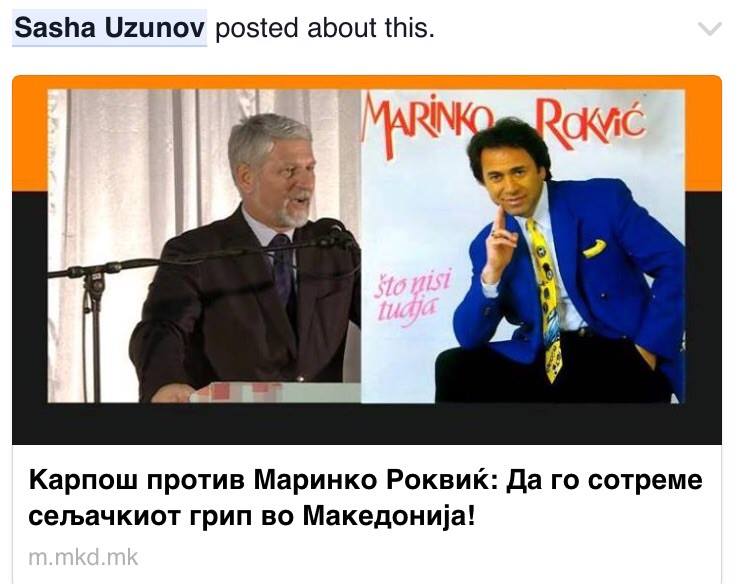
Stevce Jakimovski, an ally of Nikola Gruevski, the Mayor of Skopje suburb Karpos, came under criticism for spending public money in importing a Serbian turbo folk singer instead of using the money for other items.


OPPOSITION PARTY SDSM - flirted on a trial basis with controversial Belgrade Public Relations firm, Ruskin & Hunt, whose director Miljan Scekic, once spun for ultra Serb nationalist politician Maja Gojkovic, a staunch ally of extremist Vojislav Seselj. 


Complaints that the Gruevski VMRO-DPMNE government neglecting local Macedonian artists in favour of Serbian turbo folk artists:


CULTURAL ROLE MODEL - Riblja Corba? - link


The Leader of the Opposition Zoran Zaev says he is pro-Western and pro-EU but he draws cultural inspiration from a guy, who is anti-Western, anti-EU and anti-NATO.
I refer to Bora Djordjevic of Serb hard rock group Riblja Corba. Djordjevic is a hardline nationalist politician who was sacked for threatening Serbian jourmalists.
It remains puzzling why Mr Zaev would be drawing from Djordjevic and for that matter refusing to criticise the Macedonian government being too close to Belgrade.
Citation:
Се гледа дека лидерот на опозицијата и дај боже нашиот иден Премиер Зоран Заев на интересен и несекојдневен начин се појави во јавноста. Имено на својот фејсбук профил ја сподели популарната балканска песна од Рибља Чорба. Погледај дом свој анџеле. Текстот го објави во оригинал на српски ама и на латиница, начин да ги исмее владините спинови дека пишувал писма на латиница. Тоа предизвика експлозија од подршка на народот, преку лајкувања и коментари. Емотивна припрема пред утрешното конечно крштевање со властта, со криминалните структури кои ја урнисаа Македонија.
Pogledaj dom svoj, andjele,
I skini paucinu s ociju,
Videces prizore potresne,
Videces nesrecne I bolesne,
Videces cemer, smrt I jad.
Pogledaj stado, andjele,
Sve sami bogalji I prosjaci,
Slepi tumaraju u gomili,
Svima su kicmu polomili,
Od tebe ocekuju spas.
Pogledaj bagru, andjele,
Njihova dusa je prokleta,
Svima su stavili amove,
Sebi sagradili hramove,
Ruke im ogrezle u krv.
Podigni mac svoj, andjele,
Seti se krstaskih ratova,
Seti se preklanih vratova,
Kad dodjes bogu na istinu,
Nek ti u dusi vlada mir.
Uslisi molitve, andjele,
Dabogda pocrkali dusmani,
Pa budi andjeo osvete,
Neka na svojoj kozi osete,
Sta znaci beda, strah I bol.
-----
Bora Djordjevic's antics:
"After the political changes in Serbia, he became the Deputy to Dragan Kojadinović, Minister of Culture in Serbian Government in 2004. However, Đorđević was forced to resign from the position the next year, after accusing the journalists of the television station B92 of treason and holding anti-Serbian politics."

HOWEVER, Bulgarian nationalism, unfortunately, is making inroads into Macedonia. So you now have a Belgrade-Sofia Cultural Axis. 


DOWN THE TRACK - TEAM UZUNOV WILL EXAMINE ALBANIAN NATIONALISM IN MACEDONIA


Thursday, March 31, 2016

BLAME GAME II - The full Nestor Oginar interview


An interview with Mr Nestor Oginar, an American Macedonian community leader and dissident member of the Macedonian VMRO-DPMNE political party - after his very recent return from Macedonia. 

He offers his views over Macedonia’s political crisis, which was triggered last year by the Opposition party SDSM leader Zoran Zaev who confronted Macedonia’s Prime Minister Nikola Gruevski of the VMRO-DPMNE party with secretly taped recordings showing corrupt government dealings. Gruevski resigned in early 2016 to make way for a caretaker government and for elections sometime this year as directed by European Union intervention known as the Przino Agreement. see link

THE BLAME GAME - The previous story - link

Question 1: Your take on the political crisis in Macedonia?

Oginar: The current crisis in Macedonia is a dramatic culmination of a complex series of unresolved social issues and political problems which Macedonia inherited with the collapse of Yugoslavia and has never been wiling nor able to deal with them as it should to this very day. The nature of this crisis is many fold.

It is constitutional, political, economic, ethnic, moral but, in my view, it is rooted in the mentality of the political and intellectual establishment and projected onto the general culture of the people wherein it finds a fertile ground for growth. When you have political and intellectual leadership which has been blatantly ambiguous about its national identity, about its desire for real national independence, then you have politicians in the highest institutions of the government who openly claim and clamor for Yugoslavia, Serbia or Albania. When you are confronted with a glaring absence of a strong national center which asserts its cultural and national identity and projects it on the people, then you've planted the seeds for the development of a latent crisis which will erupt sooner or later. This is what is happening today in Macedonia.


Question 2. What, how is the way out of the quagmire for Macedonia?

Oginar: There is a way out of every quagmire, every crisis regardless of the depth and breath of its nature. However,there must be a will, determination and a know-how, qualities which are sorely lacking in today's Macedonia. History is full of examples of great leaders who have saved their countries and people from national disasters. Remember F.D. Roosevelt during the years of the Great Depression in the USA during the 1930s!? Or the role Lee Kuan Yew played in making the city state of Singapore paragon model of development, economic and cultural, after decades of all kinds of social calamities with which it had been plagued with.                                        

- THE BLAME GAME? -

Macedonia of today desperately needs leaders, intellectual and political, who will acknowledge the scope of the crisis and accept the responsibility thereof, instead of pointing accusatory fingers at each other.

Contemporary Macedonia is an ill society in every respect! It has been ill for decades, but the last 10 years have brought to the surface all the latent anomalies which had been lingering and fostering unacknowledged.                                                                  

So, the way out of the quagmire must be done in a few carefully planned steps or phases, both in a short and long run, by a new National Doctrine which must throw light upon the indisputable historical facts of the Bucharest Treaty (1913), the division of Macedonia and the plight of the Macedonian people who have been either exiled from their ancestral homes, or have found themselves denied their basic human rights to live as Macedonians within the borders of their dismembered homeland !

Furthermore:                             

a).There is an urgent need of a new national census within the Republic of Macedonia without which nothing can be accomplished;   
                                                                          
b).There must be a revision of the constitution, which has been violated and changed several times since 1991, especially since the Ohrid Frame Agreement, which rendered a totally dysfunctional Chimera of a state with so many amendments, such as the “Badinter Principle” and many others, which practically paralyse the function of all the three branches of government at local and national level;

c). Decentralisation and separation of the three branches of government which are now virtually merged into one and completely under control of the ruling party and its coalition partner;

d). Constitutional reforms which will curtail the too powerful role of the government;

e). Restructuring of the national debt, both domestic and international;
                                       
f). Increasing the role of the private sector, which has been rendered totally insignificant in the life of the Macedonian economy;
                                                                                    
g). Serious cuts and reductions in the size of the federal and local administration which is fiscally unsustainable;
                                
h). Cracking down on institutional corruption, especially in the court system;

i). Establishing a new system of hiring, based on merit and not on party affiliation and nepotism;
                                                        
j). Putting on end to all elements which adhere to the idea of creating a Greater Albania, Greater Bulgaria, Greater Serbia, Greater Greece etc. and calling for a national unity in defence of the unitary  nature of the state, its constitution and law and of course upholding and maintaining ethnic minority rights;
                                                                                          
k). Adhering to the spirit of the Przino Agreement, which calls for reforming the voting rights and lists;reforming and defining the role of independent and unbiased media along with the function of the Special Prosecutor;
                                             
l). Reaching a national consensus that the name of the country-Macedonia is sacrosanct; and

m). Putting an end to any negotiations with anybody regarding the Macedonian national name and identity.                                                    

This seems to be a Herculean task to accomplish by any government but it is feasible and it must be undertaken by any party in government for the sake of the survival and prosperity of Macedonia and the Macedonian people!                          


Question 3: Your views on Prime Minister Nikola Gruevski (2006-16) and Opposition leader Zoran Zaev?

Oginar: As a Macedonian patriot and a Macedonian  intellectual, I feel morally obliged to defend the basic tenets and principals of a free and democratic society which has been my life long pursuit because I am convinced that in defending Macedonia in principal I can help defend my country against foreign and domestic adversaries.

Macedonia's democracy today is in peril. It has been for all of its 25 years of independence, but the last 10 years of rule by the Gruevski government has taken a the most dramatic turn for the worst.  What we have today in Macedonia is a pseudo civic society ruled by an organized political mafia on the pattern of Cosa Nostra. Macedonia is governed by a single family, an extended family of Nikola Gruevski, blood related or in laws who have imposed upon the people their own brand of rule by fear, intimidation, coercion, bribe, extortion and nepotism. These are characteristics of neo-communism which borders with neo-fascism.

Nikola Gruevski took over the party VMRO-DPMNE, and in the course of ten years transformed it, from the principal founder of Macedonia, based on national ideology into a party of opportunists, sycophants and yes-men and yes -women who have abandoned the party's founding principles of unity, love for one's country and nation and devotion to the right republican ideals. He has been personally responsible for an unprecedented historical period of social decision, disunity, party affiliation, hatred and rampant crime at every level of the society. He and his ministers have been extremely liberal in their fiscal policies which are much closer to the extreme left known in communist societies.

During his mandate, Albanian irredentism has imposed control over the entire western Macedonian territories . His unnatural coalition with the UCK [Kosovo Liberation Army which launched a uprising in Macedonia in 2001 to take territory] terrorists masked as DUI [Albanian nationalist party in Macedonia led by ex KLA commander Ali Ahmeti] has paralyzed the normal functions of law and order in every national and local institution. Furthermore, he has squandered national treasure on unproductive projects such as Skopje 2014.  He has wasted time on settling accounts with his political and ideological opponents, many of whom have been expelled from the party or jailed by improvised political trials.  The catalogue if this man's misdeeds is too long to explain here.

I must mention that all of this evil in the Macedonian society has been assisted and enabled by a week and inept opposition or absence there of, especially embodied in the SDSM. It's current leader Zoran Zaev is a weak and an inexperienced man whose political life has been resuscitated over the course of the past years by the scandal of the so called "Bombs". I hold him and his party directly responsible for the current chaos and the crisis which has engulfed Macedonia. He is responsible, despite his seeming popularity, because of his latent intentions in managing the revelations by the "bombs". I consider Zoran Zaev to be nothing but a left wing liberal, political opportunist who has not been able to offer a feasible solution to get out of the quagmire .

Let us keep in mind that before he began publishing the revelations [bombs] of the Gruevski's government crimes, he had tried to negotiate a deal with Gruevski by which he would succeed him.  It was only political expediency that forced him to proceed with his plan which he and his party call "The truth for Macedonia”.

I am revolted by Zaev's opportunistic overtures to the ultra Albanian nationalist leaders to whom he promises, in violation of the Constitution, even a greater role in the future government eventually led by him. I am equally alarmed by his lack of national strategy to defend Macedonia's national name and identity.

For me, personally, Nikola Gruevski and Zoran Zaev are strongly disloyal who do not deserve to be in the position of leadership even for a day. And I hope that the growing movements toward decentralisation and democracy in their respective parties will bring about long awaited necessary changes with new people who will be willing and able to have an open national dialogue so much needed in order to achieve at lest a semblance of unity and agreement on a new doctrine which will save Macedonia from the pending crisis.


-MACEDONIA’S FOREIGN POLICY DRIFT ? -

Question 4. Macedonia’s Prime Minister Nikola Gruevski's foreign policy has been very inconsistent, to say the least! There was the positive strategic alliance with Hungary then the odd joint embassy sharing agreement with Serbia, silence on Macedonian minorities in Greece and Bulgaria and under-utilising Croatia as an “honest broker in the Balkans” to influence Kosovar Albanian nationalists to lower the temperature in Macedonia. Why is this inconsistency?

Oginar: Gruevski’s domestic and foreign policies have been inconsistent, improvisational and devoid of any sustainable national strategy, logic or rationale. This is not surprising at all considering the policies of Macedonia's previous governments lead alternately by SDSM and VMRO- DPMNE.

For decades Macedonia has been subject to centrifugal forces which have pulled the country either towards Belgrade or Sofia. This inherent strife has generated a chasm within the national fabric the consequence of which has been the penetration of the Albanian nationalist factor which is more than evident today.

- HISTORICAL FACTORS IN THE FOREGROUND AND BACKGROUND - Strong Identity, Soft identity?

I have argued that the main reason for this situation is to be found in the historical fact that Macedonia and her people, historically speaking, have never been able to live and evolve as a fully defined nation through a necessary period of a "Romantic Nationalism”- a process which has already been finished in Serbia, Bulgaria, Greece and Albania.

We can look for its causes in the Treaty of San Stefano, The Berlin Congress, the failed Ilinden uprising (1903), the Bucharest Treaty (1913) and so on as processes which have always thwarted the nascent national awakening in the consciousness of the Macedonian people.

The political and cultural influence asserted throughout these historical periods by Macedonia’s  neighbors, especially by Serbia and Bulgaria, has created a national void which is yet to be filled by a fully awaken Macedonian identity.

One can find the symptoms of these splits today both in VMRO-DPMNE and SDSM manifested in a variety of ways in the cultural and political interpretation of Macedonian daily life. Until and unless the “patriotic forces" in both of these parties prevail over the centrifugal "Vrhovisticki” [Supremacist i.e. pro Bulgarian] or Belgradist forces, we will continue oscillating between Sofia and Belgrade, between Athens and Tirana in their struggle to assert their hegemony in the very heart of the Macedonian national identity.

I expect this strife to culminate in the struggle for the preservation of our national name.

Until and unless Macedonia is soon ruled by a true patriotic national government she will continue to be the victim of the crimes of petty politicians and criminals such as [politicians both past and present] Branko Crvenkovski, Ljubco Georgievski, Ali Ahmeti, Menduh Thaci, Nikola Gruevski and Zoran Zaev whose lack of national character, will and vision has torn Macedonia apart for too long.
                             

Question 5. :  The political and cultural elite in Macedonia likes to scapegoat the diaspora, accusing it of all sorts of interference, even though not one Macedonian from abroad ever had the intention nor carried out any terrorist acts upon Macedonian soil but the reverse happened, the elite interfered in the diaspora. Why this fierce resentment of the diaspora?                                       

Oginar: The persecution of the Macedonian intelligentsia in the diaspora has a long history. The post Second World War period, since 1944-45 and on, including the Civil War in Aegean Macedonia (1946-49) under Greek occupation, marks a systematic liquidation, literal and metaphorical, of many Macedonian patriots who were forced to flee their homeland and seek refuge abroad, especially in the West.                                          

The communist regime's propaganda machinery at that time in Macedonia [Yugoslavia] created a poisonous climate of suspicion and hatred against the Macedonians abroad who were portrayed as part of the West's conspiracy to overthrow the communist government.          

Ironically, that same climate, somewhat modified, can be found in today's Macedonia. It is evident in many different ways, three of which are the most obvious:

a). MANU (Macedonian Academy of Sciences and Arts), within which during its entire existence there has not been admitted as a member any successful Macedonian from the vast diaspora;

b). The so called "Matica na Iselenicite” [Institute for Emigrants founded in each of the republics in the then Yugoslavia times 1944-91] which is still operated by UDBA (ex Yugoslav secret police) agents; and

c). A glaring absence of native Macedonian investors from the diaspora. I should like to remind you that "both sides of Macedonia's political establishment ( SDSM and VMRO-DPMNE) are one and the same political and ideological entity representing remnants of the old communist elite which ruled Macedonia during the Tito era. They are of the same ideological and mental matrix, as by the way are the so called parties of the Albanian nationalist bloc, all of which are still suspicious of any Macedonians who live abroad and strive for the ideal: unity of Macedonians!                                                      

It is supremely ironic that the same political establishment cultivates within its own respective ranks pro Yugoslav, pro Serbian, pro Bulgarian, pro Albanian and pro Greek elements which openly flaunt their loyalty to Belgrade, Sofia, Tirana or Athens.

-----------


Mr Nestor Oginar - biography in his own words:

I was born on February 3, 1947 in Skopje, Macedonia into a family of fiercely independent patriots who instilled in me the love of Macedonia.  I grew up in western Macedonia which has been the cradle of my ancestors both paternal and maternal. It was from the same region that I sought and found the greatest love of my life, my wife Milica to whom I've been married for 40 years and with whom I have three children. I emigrated from Macedonia within Yugoslavia in 1969 and I have lived in New York ever since.  I hold a BA and an MA degree in English from Hunter College of the CUNU, and from my Alma Mater, The New York University I have an MPhil and an ABD.

I have completed all of the curricular activities towards my Doctorate except for the dissertation. In 2010 I retired from a three decade long career of teaching English language and comparative literature.

I am one of the early activists of VMRO- DPMNE, it's founding representative for North America in the nineties of the past century and the original member of its Council of Intellectuals. I have co-founded the World Macedonian Congress , which I represent at the UN.

In my life-long struggle for the Macedonian Cause, I have organised, participated in and taken action in numerous rallies, demonstrations, conferences, protests and debates.

I have had many appearances, domestically and internationally on TV, radio and in the newspapers. I have for decades debated and defended Macedonia's place in the world. I have had face to face and TV and radio debates with international figures such as Mathew Nimitz, Lord George Robertson, Lawrence Eagleburger, Robin O'Neil, Emilia Boynton Robertson, a close ally of Martin Luther King, Richard Armitage, the under secretary to the then US Secretary of State Collin Powell and US Ambassadors to Macedonia, Christopher Hill and Philip Rucker, and many more.

Wednesday, March 23, 2016

THE BLAME GAME


THE BLAME GAME - Macedonia’s crisis

An interview with Mr Nestor Oginar, an American Macedonian community leader and dissident member of the Macedonian VMRO-DPMNE political party - after his very recent return from Macedonia to the United States. He is a former English teacher in the United States and holds Bachelor and Masters Degrees.

He offers his views over Macedonia’s political crisis, which was triggered last year by the Opposition party SDSM led by Zoran Zaev who confronted Macedonia’s Prime Minister Nikola Gruevski of the VMRO-DPMNE party with secretly taped recordings showing corrupt government dealings. (The full interview with Mr Oginar will follow in a separate article). A previous interview with Dr Ico Najdovski-Perin explains in detail the Cultural Crisis in Macedonia. See link

NB:
Prime Minister Gruevski resigned his position as part of an EU deal known as the Przino Agreement - see link for more details . There is now a caretaker government led by VMRO-DPMNE but with Emil Dimitriev as PM until new elections sometime this year, in which Gruevski will return as leader to contest the election.

'GRUEVSKI AND ZAEV MUST GO' -In one of the most powerful rebukes delivered by a diaspora leader:

Mr Oginar: As a Macedonian patriot and a Macedonian intellectual, I feel morally obliged to defend the basic tenets and principals of a free and democratic society which has been my life long pursuit because I am convinced that in defending Macedonia in principle I can help defend my country against foreign and domestic adversaries.

- NIKOLA GRUEVSKI

Mr Oginar: Macedonia’s democracy today is in peril. It has been for all of its 25 years of independence, but the last 10 years of rule by the Gruevski government has taken a most dramatic turn for the worst. What we have today in Macedonia is a pseudo civic society ruled by an organized political mafia on the pattern of Cosa Nostra. Macedonia is governed by a single family, an extended family of Nikola Gruevski, blood related or in laws who have imposed upon the people their own brand of rule by fear, intimidation, coercion, bribe, extortion and nepotism. These are characteristics of a neo-communism which borders with neo-fascism.

Nikola Gruevski took over the party VMRO-DPMNE, and in the course of ten years transformed it, from the principal founder of Macedonia, based on national ideology into a party of opportunists, sycophants and yes-men and women who have abandoned the party's founding principles of unity, love for one's country and nation and devotion to the right republican ideals. He has been personally responsible for an unprecedented historical period of social division, disunity, party affiliation, hatred and rampant crime at every level of the society. He and his ministers have been extremely liberal in their fiscal policies which are much closer to the extreme left known in communist societies.

During his mandate, Albanian irredentism has imposed control over the entire western Macedonian territories . His unnatural coalition with the UCK (KLA/NLA) terrorists [Ali Ahmeti] masked as DUI has paralyzed the normal functions of law and order in every national and local institution. Further more, he has squandered national treasure on unproductive projects such as Skopje 2014. He has wasted time on settling accounts with his political and ideological opponents, many of whom have been expelled from the party or jailed by improvised political trials . The catalogue of this man's misdeeds is too long to explain here."

- ZORAN ZAEV

Mr Oginar: I must mention that all of this evil in Macedonian society has been assisted and enabled by a week and inept opposition or absence there of , especially embodied in the SDSM. It's current leader Zoran Zaev is weak and an inexperienced man whose political life has been resuscitated over the course of the past years by the scandal of the so called "Bombs". I hold him and his party directly responsible for the current chaos and the crisis which has engulfed Macedonia. He is responsible, despite his seeming popularity because of his latent intentions in managing the revelations by the "bombs". I consider Zoran Zaev to be nothing but a left wing liberal, political opportunist who has not been able to offer a feasible solution for the quagmire.

Let us keep in mind that before he began publishing the revelations of the Gruevski's government crimes, he had tried to negotiate a deal with Gruevski by which he would succeed him. It was only political expediency that forced him to proceed with his plan which he and his party call "The truth for Macedonia".

I am revolted by Zaev's opportunistic overtures to the Albanian nationalist leaders to whom he promises, in violation of the Constitution, an even greater role in the future government eventually led by him. I am equally alarmed by his lack of national strategy to defend Macedonia's national name and identity.

For me, personally, Nikola Gruevski and Zoran Zaev are disloyal, and do not deserve to be in the position of leadership even for a day. And I hope that the growing movements toward decentralization and democracy in their respective parties will bring about long awaited necessary changes with new people who will be willing and able to have an open national dialogue so much needed in order to achieve at least a semblance of unity and agreement on a new doctrine which will save Macedonia from the pending crisis."

THE BLAME GAME II - other views

Some of the pro-EU pundits initially pinned the blame as to where a lot of the conflict and tensions in Macedonia have come from over the past 24 years since independence and then at the very very last minute have backed away or pulled away and pinned the blame on another cultural template, a softer target, alleged "ultra Macedonian nationalism.” Is it really to blame?

------
FINISHING LINE?

-Ex-European Union mandarin Erwan Fouere was "almost there" - as in he was on the right track - the right direction - yes, correct in mentioning the spectre of Slobodan Milosevic and Serbian cultural hegemony in Macedonia…

But he then stopped short..it remains inexplicable why?…However, he takes aim at only one party.

Erwan Fouere's quote:

"The [Gruevski VMRO-DPMNE] Macedonian government's ethno-nationalist and populist brand of politics, a throwback to the era of Slobodan Milosevic, has resulted in the re-emergence of deep tensions in a country that already witnessed a bloody ethnic conflict in 2001.”

Milosevic was in no way a "Macedonian nationalist" - quite the opposite, he was a Serbian nationalist. It's well documented that in 1992 he had offered to divide Macedonia with historical ally Greece, which has blocked Macedonia's EU and NATO bids for the past 24 years. Therefore someone "copying" Milosevic's style or the template of Milosevic's homeland, and using it in Macedonia can't be a Macedonian nationalist, whose ideological underpinning has evolved from a different historical context  than the neighbouring forms of nationalism such as Serbian, Greek, Bulgarian, Albanian, Croatian etc. So if any Macedonian politician is said to be using Milosevic tactics, he or she can't possibly be a "Macedonian nationalist" but is simply copying the cultural template from the "North" of Macedonia. Maybe the problem lies with the copying, the inability to think independently?

On the subject of "copying the North" - pardon the segue.

RUNNING WITH FOX AND HUNTING WITH THE HOUNDS?

- This from ex-Macedonian Presidential advisor Borjan Jovanovski who acknowledges where the hatred between Macedonians and Albanians is generated from but then oddly dignifies the inciters of such hatred by calling them "respected colleagues."

Quote: "I ask my [respected colleagues] poshtovane kolega from Serb who work in tabloids to stop incitement to hatred in Macedonia.”


You can only have influence, i.e. the Serb tabloids, in a foreign country, i.e. Macedonia, if the people there have been conditioned to accept, which is what has happened in Macedonia in the past during Yugoslavist times.

"KURT" RESPONSE?

This from Kurt Bassuener, from a pro EU think tank, who actually hits the mark:

No Stability without Accountability – The West’s Responsibility in Macedonia - A DPC Policy Paper
Quote:

"Unfortunately, claims of agitation for Greater Albania are not completely fanciful; there are vocal adherents of such a goal, particularly in Kosovo. A public rally at a Prishtina sports hall for the eight Kosovars killed in the Kumanovo operation, included members of Prime Minister Isa Mustafaj’s Democratic Alliance of Kosova and opposition party Vetovendosje. The Kosovo Defense Ministry refused requests to host the event officially. Xhavit Jashari, Head of the Association of Veterans’ Families, said of the men “They are heroes of Kosovo. They fought for the freedom of the occupied lands, and for their unification in one country, Albania.“

"This direct endorsement by major political figures of ethnic separatism in Macedonia is a dangerous and destabilizing escalation of inter ethnic and interstate tension, and is generating ample fodder for regime-oriented press in Skopje, Belgrade, Banja Luka, Moscow, and beyond.

"The lack of a clear and credible Western security guarantee for Macedonian territorial integrity and sovereignty – even identity – has left ample room for nationalists throughout the region to entertain grand designs, as well as giving Moscow inroads in a country in which it had few.” Link
----
STRANGE ABOUT-TURN?

-This from staunch critic of the current Macedonian government pundit, Saso Ordanoski, from way back in 1994, despite the political elements he criticised back then not having changed their platform today in 2016 even though Ordanoski has:

“Throughout the formation of Macedonia, they [Albanian nationalist bloc] have boycotted all political processes that would link them to it," said Saso Ordanoski, Skopje's leading commentator. "It is quite clear that their eventual aim is to declare their own federal republic and secede within [from] Macedonia.” link
---
TWO TEMPLATES WHICH ARE IMPORTED?

Surely, if the EU pundits know which two cultural templates, that is forms of extreme nationalism, Serbian and Kosovar Albanian are to blame, why then do they pin the blame on the wrong cultural template - alleged "ultra Macedonian nationalism." It doesn't make sense?

ANY INSIGHT?


Sinisa Jakov Marusic (right in photo), a number of experienced old Balkan hands have told Team Uzunov, has virtually come out of nowhere to be ensconced as the head reporter for a pro European Union website called Balkan Insight, which despite breaking some good stories about corruption, has an obsession with replicating another Yugoslavia and pinning the blame on Macedonia’s problems on alleged “ultra Macedonian nationalism,” ignoring the powerful effect of Serbian cultural hegemony and Yugoslavist culture upon Macedonia, which has also impacted upon both of Macedonia’s political parties.

In an allegory of Balkan Insight’s Yugoslavist obsession - Mr Marusic joined commentators from Belgrade and Sarajevo speaking in Serbian about statutes in Belgrade and Skopje, the Serb and Macedonian capitals. see link. Why the need to link Macedonia with Serbia or for that Bosnia? No disrespect to the Serb and Bosnian peoples, but I am sure they also appreciate their independence, as do the Macedonians.


"Books, brother, books, not [church] bells and sleigh bells” - 
"Knjige, braćo moja, knjige, a ne zvona i praporce” - Dositej Obradovic (1739-1811)

It is a paradox for a man who critiques “ultra Macedonian nationalism” as Mr Marusic does so with relish but to have as his Facebook profile photo, a controversial and provocative quote from a 19th century Serb nationalist by the name of Dositej Obradovic, who according to Austrian academic, Wladimir Fischer, Obradovic believed in a form of dictatorship known as “enlightened despotism” where Serbia’s ruling elite should abandoned superstition and embrace books, secular education and submit to the Austrian Emperor. It is a very very odd ideology. Fischer also points out Obradovic was against democracy for the masses:


"Obradovic was not, as his interpreters often have it, in favor of democracy and equality; he was a champion of enlightened despotism.” see link 

Obradovic’s legacy has been misunderstood and misused by Serb nationalists, secularists and internationalists (in an ex Yugoslavist sense).

TEAM UZUNOV has attempted to contact Mr Marusic (initially on 28 February 2016) to offer his perspectives on the crisis in Macedonia and why his choice of Obradovic quote , but we have not received a response, despite a few more follow up emails.


Wednesday, March 16, 2016

ZAEV CALLING - a long time coming

ZAEV CALLING - a long time coming 
by Sasha Uzunov

Macedonia’s Opposition leader from the SDSM Party, Mr Zoran Zaev, gave a very rare interview for influential Australian-Macedonian radio program, 3ZZZ, hosted by Dr Ico Najdovski-Perin, and in which he gave a public undertaking not to change Macedonia’s name over Greek pressure. (more about Dr Najdovski-Perin here at this link.)

It remains to be seen if Mr Zaev will keep his commitment not to change the name, should he become Prime Minister after 5 June 2016, the date of the elections. Those elections were initially scheduled for 24 April as part of the EU Przino Agreement, which saw Prime Minister Nikola Gruevski resign because of the on-going political crisis and handing over to a caretaker government led by his VMRO-DPMNE party. However, that the date was pushed back to June, after the EU claimed it was not happy with a number of conditions such as a scrutiny of the electoral rolls, media freedoms and so on.

Be that as it may, Mr Zaev should have come on earlier on 3ZZZ radio, an independent multicutlural broadcaster with enormous reach in Australia, talking directly to the Australian-Macedonian diaspora. It remains puzzling why Mr Zaev has kept the diaspora, which ironically lives in the West, at arms length even though he claims to be pro-West?

It’s a very obvious question and in fact begs to be asked, why Mr Zaev’s media handlers or advisors have been keeping him from re-engaging directly with the Australian Macedonian diaspora which lives in the political West; rather than just giving soundbites used by the Australian-Macedonian media?

Macedonia's first President since independence in 1991, Kiro Gligorov of SDSM (1991-99) cleverly brought the diaspora under his wing as he battled to keep Macedonia alive and recognised. He had diaspora Macedonian men and women of the calibre of Canadian John Bitove & American businessman Vuko Tashkovich-whose son Gligor, became a minister in the Gruevski government for a short period of time and brought in huge investments in the country- and American-Macedonian woman Ms Ljubica Ackovska appointed as US Ambassador in the mid 1990s.

A father and son - Vuko and Gligor Tashkovich can serve two opposing parties in Macedonia -SDSM and VMRO-DPMNE - because they put the national interest first, is what many in the Australian diaspora are saying.

Many Australian-Macedonians tend to vote for the Australian Labor Party (ALP) which is the equivalent of SDSM but have largely favoured the nominally “nationalist” VMRO-DPMNE in Macedonia, which has run the country under Prime Minister Mr Nikola Gruevski for a decade, and with the PM recently forced to resign over a year long political crisis brought on by Mr Zaev releasing secretly recorded conversations involving the Gruevski government and alleged wrongdoing and massive corruption.

Part of that problem with SDSM’s media image in Australia is a perception of abandoning the diaspora for what is perceived as Belgrade cafe culturalists masquerading as pro West. This image or perception has been effectively used by VMRO-DPMNE supporters in Australia.

Hopefully Mr Zaev will re-examine that perception and draw the diaspora towards him.

No Macedonian from Australia has ever committed an act of terrorism on Macedonian soil. But "citizens" - predominately ethnic Albanians - from the Republic of Macedonia are fighting in Syria and Iraq. Pre-1991, Macedonian officials from SRM / SFR Yugoslavia’s secret police, UDBa (SDB), threatened Macedonians in Australia with violence or death. Mr Ali Ahmeti, the ethnic Albanian leader who started the war in Macedonia in 2001, came from the Swiss-Albanian diaspora.

So it remains puzzling why this aloofness towards the Macedonian diaspora now & not just from Mr Zaev but from the whole political and cultural class in Macedonia?


PERCEPTIONS 

Mr Zaev needs to lessen the influence of the City of Skopje / Belgrade Cafe cultural faction which has attached itself to SDSM, such as pundits Borjan Jovanovski and Branko Geroski, who claim to be pro West, and from time to time just say enough on “international television” to cover their tracks and criticise Belgrade but without really meaning it - they cleverly sit on two chairs…

Other perceptions include that SDSM and the ruling VMRO-DPMNE have deliberately ignored the plight of ethnic Macedonians in neighbouring Greece, Bulgaria and Albania. Some say that the ethnic Macedonians in Albania act as a healthy and natural barrier to a perceived Greater Albania in Western Macedonia, and Macedonia is being held politically hostage by Ali Ahmeti and his demands.

Moreover, there is a feeling that Serbia still wields “too much cultural hegemony” in Macedonia with the enomous power of ultra-nationalist tabloids from Belgrade. Likwise, that the European Union and the US have “bullied Macedonia” and given the Albanian nationalist bloc cart blanche; that Bulgarian nationalists have been allowed to set up shop in Macedonia unhindered. And not forgetting the strong belief in the influence of George Soros and is foundation.

Whatever the basis may be for these perceptions, they need to be discussed, debated, examined and not allowed to just circulate or linger or drift in the public square.

What is a given, or a fact is corruption in Macedonia is widespread and didn’t start in 1991.

WESTERN INACTION? DRIFT?

DPC is a pro West think tank and it's interesting it has criticised certain aspects of the West's behaviour in the BALKANS. Kurt Bassuener wrote in 2015 in a DPC paper - see link here :

Quote:

"Unfortunately, claims of agitation for Greater Albania are not completely fanciful; there are vocal adherents of such a goal, particularly in Kosovo. A public rally at a Prishtina sports hall for the eight Kosovars killed in the Kumanovo operation, included members of Prime Minister Isa Mustafaj’s Democratic Alliance of Kosova and opposition party Vetovendosje. The Kosovo Defense Ministry refused requests to host the event officially. Xhavit Jashari, Head of the Association of Veterans’ Families, said of the men “They are heroes of Kosovo. They fought for the freedom of the occupied lands, and for their unification in one country, Albania.“

"This direct endorsement by major political figures of ethnic separatism in Macedonia is a dangerous and destabilizing escalation of interethnic and interstate tension, and is generating ample fodder for regime-oriented press in Skopje, Belgrade, Banja Luka, Moscow, and beyond.

"The lack of a clear and credible Western security guarantee for Macedonian territorial integrity and sovereignty – even identity – has left ample room for nationalists throughout the region to entertain grand designs, as well as giving Moscow inroads in a country in which it had few.”

In 1994, Saso Ordanoski, a pro SDSM journalist and former head of Macedonian State broadcaster (MRT), told the British press that the Albanian political bloc in Macedonia:

“Throughout the formation of Macedonia, they have boycotted all political processes that would link them to it," said Saso Ordanoski, Skopje's leading commentator. "It is quite clear that their eventual aim is to declare their own federal republic and secede within [from] Macedonia.”

source: The Canberra Times (ACT) Friday 11 March 1994 quoting The Guardian newspaper. Reporter Helena Smith. link.

But he has done a 360 degree turn since then, why? Even Bassuener in 2015 concurs that a Greater Albania remains a genuine threat to Macedonia’s very existence.

There are also fears that Macedonia will be forced to change its name, because for the EU it’s the “path of least resistance” to take in order to appease an obstinate Greece, which has blocked Macedonia’s membership in the EU and NATO.  see link


ESTABLISHMENT

Mr Zaev is not part of the traditional City of Skopje cultural elite which dominates Macedonia and Macedonian culture. He is an outsider from Strumica and was arrogantly ridiculed by one of his own supporters, journalist Olivera Trajkovska, for being from outside Skopje. Therefore, Mr Zaev should at least try to feel some empathy for Macedonians who are outside the capital city and who also are treated in an arrogant manner by the established elite.

From a strategic and economic view, that is, and Mr Zaev has confirmed this, the Macedonian diaspora brings in a Billion euros annually, which are badly needed in Macedonia. This money comes in without any strings attached to it - via tourism, pensions, money being sent to family members, investments etc.

FUNCTIONING JUDICIAL SYSTEM?

Mr Zaev will find that many Australian-Macedonians have been the victim of protracted civil legal cases dealing with property inheritance of a family home or farm in Macedonia - where Macedonia's judicial system for the past 25 years has deliberately dragged out cases with appeals and counter appeals, so that lawyers and judges can keep the gravy train (fees, kickbacks, bribes etc) from rolling on.

I personally know of one Macedonian man from Melbourne who has spent over $400,000 and maybe more over a decade and half in legal fees in Macedonia. He has been physically attacked by the opposing side outside court, trying to intimidate him into giving up his claim, whilst the authorites have done nothing. These are the people that Mr Zaev needs to reach out in the diaspora - people who for 25 years have been on the receiving end of an atrocious legal system and mistreatment by authorities, regarldess of their political affiliation.

PUBLIC PERCEPTIONS II?

Messrs Jovanovski and Geroski’s personal hobby of a curious and contradictory mish-mash of internationalism, old time Yugoslavist nostalgia, Belgrade cafe culture as well as saying “vise, bolje, u” - and naively eulogising opportunist politician Zoran Djindjic etc. doesn’t bring in a Billion euros and in fact alienates support for SDSM in Australia !

THE ZAEV INTERVIEW:


What is encouraging is Mr Zaev didn't use the patronising “elite” words such as"vise, bolje, u" - a small positive step - during the interview.

Some tough questions were posed by host by Dr Najdovski-Perin (pictured left): about the influence of DUI, Ali Ahmeti, no census of the population, EU interference, Przino Agreements, de-facto Federalisation, ignoring ethnic Macedonians in Albania, Greece, Bulgaria etc. Mr Zaev appeared evasive at times.

However,


- Mr Zaev gave an undertaking not to change Macedonia's name.

- Mr Zaev acknowledged that the diaspora contributes over 1 billion euros to the Macedonian economy annually, which is badly needed.


Monday, March 14, 2016

THE VIEW FROM BUDAPEST

THE VIEW FROM BUDAPEST: HUNGARIAN-MACEDONIAN RELATIONS

- by Sasha Uzunov

In December 2012, Hungary led by the larger than life, some would say bombastic, Prime Minister Viktor Orban, recognised Macedonia under its constitutional name much to the chagrin of Greece which has blocked Macedonia’s EU and NATO membership applications for over twenty years. Greece is staunchly and stubbornly opposed to the use of the name of Macedonia.

Hungary is both a European Union and NATO member.

The reaction from certain quarters in Macedonia, ironically from people claiming to be pro-West was, to put it, a strange combination of anti-Hungarian sentiment and geo-strategic naivety, and above all else inconsistent. see link. The same level of blow-torch intense scrutiny was not applied to the Macedonian government agreeing to share embassies with Serbia, which has no intention of joing NATO.

Interview with Mr László Szentesi Zöldi 
Born in 1970. Hungarian journalist, columnist, writer. He has worked as a reporter and editor for Hungarian Television (MTV), Duna Televison, Echo Television, a journalist for the Foreign Desk at daily newspaper Magyar Nemzet, Deputy-Editor-In-Chief at daily newspaper Magyar Hírlap. He is currently a columnist for weekly Magyar Demokrata in Budapest. László Szentesi Zöldi has reported from many countries, including Northern Ireland, Bosnia, Iraq, Turkey, Taiwan, China.

Question 1: As a Hungarian journalist what are your views on the ever deepening Hungarian-Macedonian diplomatic relations? Macedonia doesn’t have too many friends in the Balkans, with the exception of Hungary and Croatia, which because of being tied up in internal politicking has allowed Serbia to take a more assertive role in the southern Balkans and in Macedonia but Zagreb has now began to readress that.

László Szentesi Zöldi: Our diplomatic relations are very good. Some weeks ago Macedonia’s Foreign Minister Mr Nikola Popovski visited Budapest, the Hungarian capital. I wouldn't say his talks with his Hungarian colleague were cool or unfriendly. When Hungary's Foreign Minister, Mr Péter Szijjártó declared that "Macedonia should have been invited to join NATO long ago, and the EU should have started accession talks at least six years ago”, that tells you of the deepening Hungarian-Macedonian relations and mutal affection - these are more important than the usual stock words and phrases, and cliches of diplomatic communiques. Macedonia is a very important partner for the countries in the Visegrád Group - cooperation (Hungary, Poland, Czech Republic, Slovakia - see link) as a small but stable country that would help keep the balance between different powers in the Balkans. Beyond that, Hungarians simply like Macedonians. Although Macedonia is far from the Serbian-Hungarian or Croatian-Hungarian border, we have travelled a lot in the former Yugoslavia, many Hungarians have nice memories of Skopje, Stara Carsija [old Turkish bazar] or rakija [brandy]. This has nothing to do with politics, but I often cook tavce gravce [Macedonian traditional dish of baked means and meat] for my friends!

Hungarian PM Viktor Orban (left) receives an Order Of Macedonia award from Macedonia’s President George Ivanov.

Question 2: There has been a ferocious attack or campaign against Hungary and in particular the Prime Minister Viktor Orbán by Macedonian pundit, self proclaimed human rights activist and a former presidential advisor Borjan Jovanovski. We all know that it’s a journalist’s job to criticise all politicians, including Orban, but you find it strange that the same level of scrutiny is not applied to say Serbian President Tomislav Nikolic and Serbian Prime Minister Alexander Vucic, who are Serbian nationalists at heart. Serbia is not an EU or NATO member. It has an atrocious human rights record and has made some very loud nationalistic murmurs recently, such as the rehabilitation of ultra nationalist leaders, Draza Mihailovic, or the provocative statements against Macedonia (Serbian Foreign Minister Ivica Dacic’s complaints about Macedonia’s support for Kosovo’s UNESCO application). see link & another link 

László Szentesi Zöldi: It's always a suprise when human rights activist attacks an independent and democratic state such as Hungary, but obviously, these critics know nothing about its internal or domestic politics. I think after the wars in the former Yugoslavia in the early 1990s, especially the siege of Sarajevo and Srebrenica massacres, it's difficult to believe in "universal values" in our region. Human rights talks are largely about empty promises, we have to be more practical. It’s probably better to respect the right of all governments to govern by their own rules, without violence or despotism, of course. However, let me point out that Mr Orbán never urged that we should kill 100 Serbs if they kill just one Hungarian, the way in which Serbian PM Vucic did in 1995 when he warned that 100 Muslim Bosnians would be killed for every one Serb (see link).  By the way, we, Serbs, Macedonians, Croats, Slovenians, Hungarians should unite somehow against illegal migration. This is a real danger, and we can see the difference between the dreamy utopia and hard reality; so called "universal values' and protection of borders - Western illusions and Eastern realism. It can hardly be a coincidence that without hesitation or after a short pause, the EU’s members all want to built fences. As for the situation in Macedonia, if you let in the endless unregulated or unscreened crowds of migrants in the near future, your problems will only get worse.


Twitter: Mr Borjan Jovanovski, a former Macedonian Presidential advisor, in a note deliberately written in Macedonian with some Serbian words thrown in, cheekily says: “concerns about certain things in Serbia being banned, hey stop exaggerating.” However, in an English note, he calls for protests against Hungary. In the meantime, Mr Jovanovski has not called for any protests against Serbia or rising Serbian nationalism.

But when asked if he would condemn the Serbian Foreign Minister Ivica Dacic,  Mr Jovanovski said nothing. Mr Jovanovski is also a self-appointed human rights activist who paradoxically years for the former Yugoslavia, a one party state. see link


Question 3: In your opinion why is there this campaign against Hungary in Macedonia but Serbia gets treated softly?

László Szentesi Zöldi:: Because of emotional and historical reasons Serbia might be closer to some members of Macedonia's political class. It's a fact. As far as I can see Macedonian identity is a very complex question for the Macedonians themselves, but at the same time an irritating thing for Greece, Bulgaria and Serbia. If someone really thinks that Serbia is a land of paradise whilst Hungary has a terrible, anti-democratic governement, I have to strongly disagree with this extreme and unjust assertion.  Old-fashioned Serbian nationalism which still exists in Belgrade blocks hope to do real changes for a better future. But the campaign against Hungary is over. We just built a fence, and our neighbours simply followed the example. This time, after being criticised, Mr Orbán is a very popular politician all over in Europe, which is a suprising phenomenon, but at the same time this campaign against was waged by those who support socialist-led ideology.

Photo caption: Mr Csaba Sogor (left) pictured with Nobel Peace Prize winner The Dalai Lama.

Question 4: Ethnic Hungarian MEP from Romania Csaba Sogor has bravely stood up against the bullies from Golden Dawn, an extreme nationalist, neo-Nazi Greek political party at a European Parliamentary conference on ethnic minorities who live in Greece, namely Turks, Macedonians and others.  see link  - What can you tell us about Mr Sogor?

László Szentesi Zöldi: Mr Sogor is a protestant clergyman, a former senator for the Democratic Union of Hungarians in the Romanian Parliament; he is a popular and respected politician in Transylvania. As a Member of the European Parliament (MEP) he represents 1.5 million ethnic Hungarians in Romania, one of the largest national ethnic minority groups in Europe. Mr Sógor is a very friendly and open person, that's why he was willing to stand up and react to the nasty threats and shouts from the "Crazy Greek Golden Dawn.” It was not just about politics but two different ways of thinking, two different philosophies. I enjoyed watching the verbal confrontation, especially when Mr Sógor shouted back at the Golden Dawn extremists that it's no use to “shield" the whole Greek nation-state from the conference. Mr Sogor also mentioned that some Slovakian and Romanian politicians were also pandering to unjustified nationalistic fears about ethnic Hungarians in those two respective countries, so he knew exactly how to react to the shouts and threats from the Golden Dawn MEPs in the room: He said to them "get out and shut up!" This kind of situation is not a very comfortable one to deal with but it truthfully must be confronted, especially in reacting to Golden Dawn.
-
TEAM UZUNOV- Mr Sogor has also raised issues relating to the very large Hungarian minority in Serbia  - at this link
-----


Thursday, March 10, 2016

Embassy to remain in Belgrade


AUSTRALIAN EMBASSY TO REMAIN IN BELGRADE
by Sasha Uzunov

TEAM UZUNOV exclusive - Australia rules out moving embassy to Skopje, Macedonia - Canberra regards Serbia of more strategic importance.

Australia’s Department of Foreign Affairs and Trade (DFAT) has ruled out relocating its Embassy in Belgrade, Serbia to Skopje, Macedonia, despite Serbia not wanting to join NATO, of which Australia, a non member is a strong ally of. Instead DFAT has cited “costs” over a possible move.

This statement from DFAT spokesperson Tom Battams:

"Australia values its relationship with the former Yugoslav Republic of Macedonia. Our assessment, however, is that Australian interests are currently appropriately served through our Embassy in Belgrade, supported by our Honorary Consul in Skopje.

"Decisions to establish Australian Embassies and Consulates are not taken lightly.  A number of factors are considered, including, but not limited to:
.                 government-to-government, trade, cultural and tourism linkages;
.                 the consular and passport workload in the location;
.                 the size of the resident Australian population; as well as
.                 the initial and recurrent costs.

"Australia’s Ambassador in Belgrade, Ms Julia Feeney, is very aware of the importance that Australians of Macedonian descent attach to a range of services and assistance provided by diplomatic and consular representatives in Belgrade and Skopje."

TEAM UZUNOV QUESTIONS - the above statement from DFAT on the Embassy was a response to our questions below:


Foreign Minister, Ms Julie Bishop (left), I wanted to ask you if the Australian government would consider moving its Embassy in Belgrade, Serbia to Skopje, The Republic of Macedonia?

reasons:

1. It would be a saving to the DFAT budget to set up in Macedonia;

2. There are more people in Australia who have Macedonian ancestry and who speak Macedonian than there are people of Serbian extraction. The Embassy would be of more use located in Skopje than in Belgrade in terms of “traffic.” I cite the 2011 Australian Bureau of Statistics figures, which places Macedonian as the fourth most spoken non-English [non-Asian] language in Australia;

3. Serbia is not a member of NATO and has no intention of joining NATO, whilst Macedonia is a candidate member. Australia, though not a member of NATO, is a close ally of NATO. Both Macedonia and Australia have contributed troops to the various NATO missions in Afghanistan, whilst Serbia hasn’t.

4. There is no strategic need to have an Australian Embassy in Belgrade, which could be covered from Skopje. Our Canadian and American allies, who both have Embassies in Belgrade, would more than adequately keep Canberra informed of political developments in Serbia.

CANADA STAYING PUT


 Canada will also be staying put in Belgrade and not relocate to Skopje - link 

 The Macedonian government of Prime Minister Mr Nikola Gruevski, VMRO-DMNE party, signed a “joint diplomatic” sharing mission agreement with Serbia in 2014. Serbia has made it known it does not seek NATO membership, which Macedonia is a candidate of.
"Wouldn’t sharing buildings housing embassies or consulates with Serbia pose a security threat to Macedonia, should it become a NATO member, as in compromise sensitive NATO material because of the proximity?
"Canada does not have an Embassy in Skopje, Macedonia. Why is that? If Macedonia becomes a NATO member--Serbia has no interest in NATO membership--should not Ottawa move its Embassy to Skopje?"
AMBASSADOR PINNINGTON: "The Embassy carefully follows events in the three countries to which we are accredited: Serbia, Macedonia and Montenegro. We are monitoring the situation in Macedonia. However, we are not in a position to comment on arrangements between private companies and political parties in Macedonia, or on the relations, or specific arrangements, between Macedonia and Serbia.
"With respect to the location of our Embassy, Global Affairs Canada is always examining where Canadian resources should be allocated to ensure Canadian interests are protected and promoted in the most effective and efficient manner."