Wednesday, February 27, 2013

ASIO RELEASE MORE YUGO SPY FILES

ASIO surveillance photo of Georgi Trajkovski from 1979. Pictured here leaving his 
consular vehicle, a Mercedes Benz. source: National Archives of Australia


by Sasha Uzunov

ASIO - The Australian Security Intelligence Organisation (ASIO) has released three more dossiers, bringing the total to five so far, for Yugoslav Consul General in Melbourne Georgi Trajkovski, believed to be the mastermind behind a covert operation to discredit emigre Croats and Macedonians during the 1970s.

ASIO, the domestic counter-intelligence service, kept a close watch on Trajkovski, who was Consul General from 1975-79.

According to this 1978 ASIO report, local Macedonians were not regarded as terrorists or posed a security threat. The report suggests that the violence within the community was caused by the Communist Yugoslav government's battle to take control of Australian Macedonian Orthodox Churches.


This same report reveals the struggle between the Yugoslav government and an apocryphally named Macedonian nationalist organisation DOOM (MLUM - Movement for the Liberation and Unification of Macedonia).


In 1976 the situation was worsened when Bishop Kiril (Cyril) was sent by Communist Yugoslavia to induce the local churches to hand over their assets to the Skopje patriarchy. (Photo: National Archives of Australia, 1973)


ASIO surveillance photo of Georgi Trajkovski from 1979. Pictured is his consular vehicle, a Mercedes Benz. Trajkovski is partly obscured at a fancy Melbourne restaurant at the time, Troika.

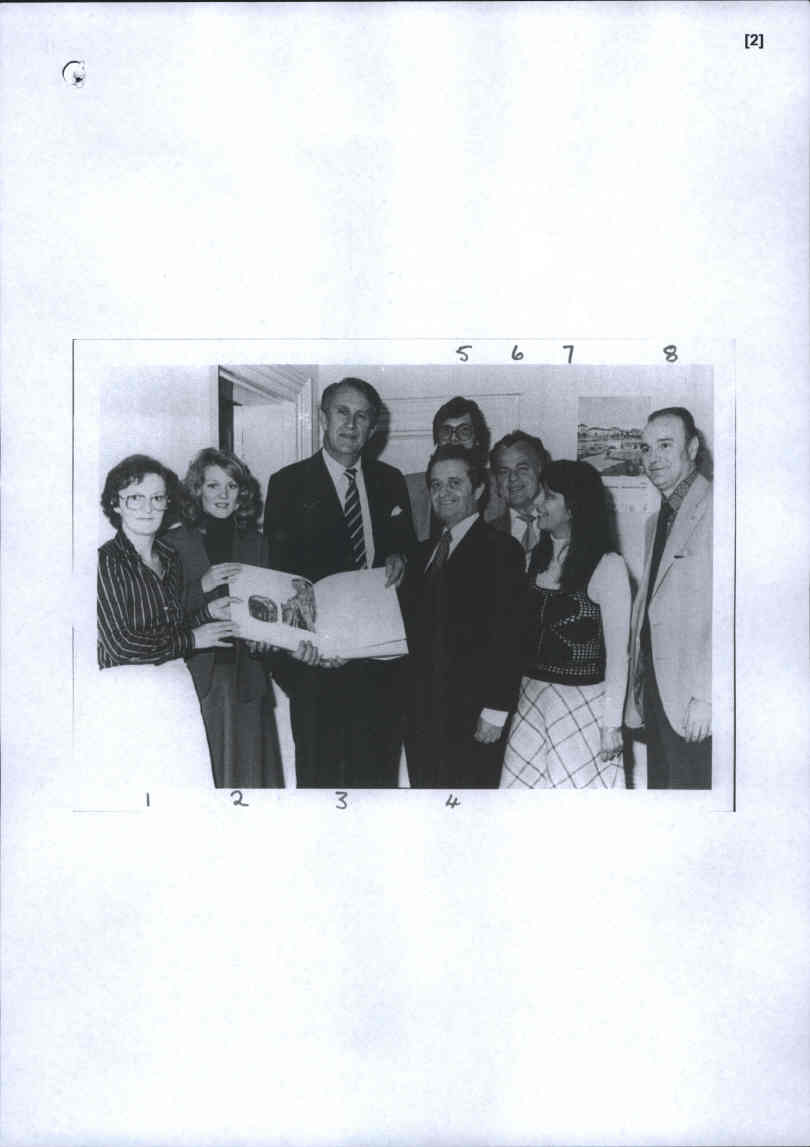
Photo of Australian Prime Minister Malcolm Fraser (1975-83), in the centre of photo, visiting the Yugoslav Consulate in Hawthorn, Melbourne in 1979 and holding a book. On his left is Trajkovski (numbered 4) and far left is Petar "Pero" Lombardic (numbered 8), Trajkovski's second deputy and hatchet man. Missing from the photo is Anastas "Aco" Stojanovski, first deputy. source: National Archives of Australia

More to follow on this story

Thursday, February 07, 2013

ENTER THE DRAGANS & THE RED PRIEST !

Yugoslav spying in Australia
ENTER THE DRAGANS & THE RED PRIEST !
by Sasha Uzunov

It could easily be a plot for a Bruce Lee martial arts film or a Quentin Tarantino blockbuster but fact is stranger than fiction. Here in Australia during the early 1970s, clergy, petty thieves, ex-communicated communists, embezzlers, gamblers, bar room brawlers, and international con men were used by the Yugoslav communist secret police, the dreaded UDBa, to spy and intimidate dissident Croats and Macedonians.

According to a de-classified intelligence report compiled by Australia's domestic spies (ASIO), one method of "recruitment" involved the use of a pro-Yugoslav communist Macedonian Orthodox Christian priest, later de-frocked, who in 1976 offered to act as a character witness in a Melbourne court for a known street brawler of Macedonian background, Dragan "Dragi" Gastevski (aka GASHTEVSKI)--who was facing a criminal charge--in return for spying upon Macedonians and Croats.


ASIO was monitoring the Red Priest because of his pro-Yugoslav communist activities and opened a file on him.

In this ASIO document on Yugoslav diplomat George Trajkovski in 1976 the Red Priest and Gastevski are mentioned at the bottom of the page.

The ASIO report also details Yugoslav government intimidation of the Sveti Georgi (Saint George) Macedonian Orthodox Church in Fitzroy, Melbourne.


ENTER THE DRAGAN 1 - Street brawler Dragan "Dragi" Gastevski (1946-2012), born in the village of Capari, near the town of Bitola in modern day The Republic of Macedonia, which declared its independence from communist Yugoslavia in 1991. Gastevski was facing a criminal assault charge in 1976 for beating up a pro-Yugoslav Macedonian community leader at Preston Town Hall in Melbourne's north. The Red Priest offered to act as a character witness.


Serving two masters? Caesar and God? 

The Red Priest, pictured here conducting a Macedonian Orthodox Christian Baptism circa 1970s.

After the fall of Yugoslav communism in 1991, the Red Priest was de-frocked for selling unauthorised souvenirs, such as crucifixes, without church permission.


Melbourne Macedonian community sources have told TEAM UZUNOV that Gastevski tried to throw his weight around in Sydney's Macedonian community but was run out of town and unofficially banned from ever stepping foot in the harbour city.

Gastevski was active in the Sveti Nikola (Saint Nicholas) Macedonian Orthodox Church in Preston and a close associate of pro-Yugoslav communist Georgi "George" Pisevski, a one time President of Sveti Nikola Church.

Georgi "George" Pisevski (1922-2012) was a Macedonian Partizan resistance fighter during World War II and a high ranking Yugoslav communist party member who after the war became a manager of a state owned company called ZIK Tetovo in the western Macedonian town of Tetovo, then under Yugoslav communist control. Pisevski served in the Macedonian Socialist Republican Parliament during the Yugoslav era.

He fled Yugoslavia in the mid 1960s and arrived in Melbourne, Australia, after embezzling funds from the state owned company. In order to be able to return to his homeland of Macedonia, he began working closely with Yugoslav diplomats in Melbourne.

Pisevski was named in an ASIO file belonging to Yugoslav Consul General Georgi Trajkovski (1975-79) who bragged about infiltrating and silencing anti-Yugoslav activities in Melbourne.


Trajkovski's ASIO file mentioning Pisevski.


An American expert on UDBa, Dr John Schindler, has uncovered in his research the links between the former Yugoslav communist intelligence service and criminals, who were used to carry out assassinations or attacks on emigre Croats in particular living in the West during the 1970s. Serbian militia leader during the Yugoslav Wars of the 1990s, Zeljko Raznjatovic-Arkan, began as an armed bank robber in Holland and Belgium and also did work for UDBa during the 1970s.


ENTER THE DRAGAN 2 - WHO WAS THE REAL DRAGAN BUBEVICH / BUBEV ?

Dragan Bubevich aka Bubev or Bubevski (1925-2011) was involved in the Sveti Georgi (Saint George) Macedonian Orthodox Church in Fitzroy, Melbourne during the 1960s through to the 1980s and was present during the struggles by the church to resist being taken by the Yugoslav communist government in 1976 (see above ASIO file on the Red Priest and Gastevski).


Bubevich created this image of a Macedonian political dissident who escaped from Yugoslavia after being imprisoned by the Yugoslav communist authorities during the 1940s and 50s and had allegedly shared a prison cell with popular Macedonian non-communist leader and Partizan resistance fighter during World War II, Metodija Andonov-Cento, imprisoned on false charges during a communist show trial in 1946 at the behest of Yugoslav leader Marshal Josip Broz Tito.

There are conflicting reports over where and when Bubevich was born. His tombstone at Fawkner Cemetery in Melbourne's north lists the village of Gjavato, near the town of Bitola, in the present day The Republic of Macedonia and the date as 25 January 1925. The mystery does not end there. The official Fawkner Cemetery records lists Bubevich as Bubevich and not Bubev as his tombstone.


Tombstone written in Macedonian (Latin script)

Here rests Dragan Bubev.
Born 25-1-1925
in the Village of Gjavato, Bitola.
Died 17-3-2011


A relative of the Bubevich family has told TEAM UZUNOV that Bubevich was indeed in prison but for extortion. He had kidnapped the young son of a fellow Macedonian villager who was working in the United States and demanded a ransom. Bubevich was imprisoned. One version has it that once his sentence was served he fled across the border into Greece and eventually made his way to Australia by boat.

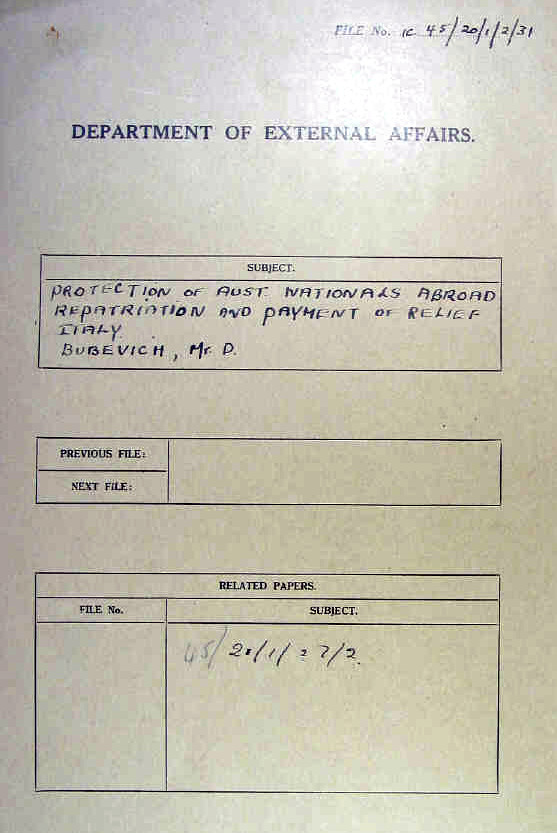
However, an Australian External Affairs (later renamed the Department of Foreign Affairs and Trade) document dating from 1945 had Bubevich claiming he was born in Perth, Western Australia on 25 March 1925 and applied to be repatriated to Australia.


Bubevich made the extraordinary and highly contradictory claim hat he had fought with the legendary Macedonian Partizan hero Stif Naumov (Naumof) during World War II. He then escaped to the mountains until the end of the war before crossing over into Greece and fighting against ELAS, the Greek Communist resistance, even though ELAS had fought the Axis and was a de-facto ally of the Macedonian and Yugoslav Partizans. Bubevich further claims he joined the British in Solun (Salonika) and eventually arrived in a refugee camp in Italy.

This probably was an attempt to curry favour with the British. The document does not indicate whether Bubevich was "repatriated" to Australia. TEAM UZUNOV will apply for Bubevich's immigration records through the National Archives of Australia to unravel this mystery.

A  Stojan Bubevic, the father of Dragan, is mentioned in Australian naturalisation papers. He lists his place of birth as Giavato, Bitolj, which prior to World War II was under the Serbian monarchy of Yugoslavia but refers to Gjavato, Bitola.


VIETNAM DRAFT DODGER FOR HIRE

A relative of the Bubevich family has told TEAM UZUNOV that Dragan Bubevich in 1967 at the height of the Vietnam War offered to "fix for a friend from his village with the Australian government not to conscript his 20 year old son, newly arrived in Australia, for military service in Vietnam." It is alleged Bubevich demanded and was paid $500, a huge sum back in the mid 1960s for migrant workers.

However, the scam was exposed when the Commonwealth Police (forerunner of the Australian Federal Police) came knocking on the young man's door for ignoring his national service call up.

It has been further alleged that Bubevich had dealings with ethnic related organised crime groups in Melbourne and worked as an informer for Yugoslav intelligence, UDBa.

He at one time was a part-owner of an inner city pub in Melbourne during the 1980s.

(end)

UPDATE: Friday 27 September 2013

BITOLA - World War II - 70 Year mystery? Did Dragan Bubevich betray or help Macedonian Partizan hero Stevan 'Stif' Naumov in 1942? Or was Bubevich a clever conman who told an elaborate story?


Going through an old story of mine on Dragan Bubevich, a controversial figure in Australia's Macedonian community I made the realisation that there is loose circumstantial evidence at best to link Bubevich to Naumov. It would be great if we could access the Macedonian intelligence files on Naumov and Bubevich to see if my hunch or theory holds any water.


I came across an old Australian Immigration file in the National Archives of Australia - www.naa.gov.au - in which Bubevich gave a statement in 1945, whilst in an Italian refugee camp. How he ended up there no one knows or why?


Bubevich made the extraordinary and highly contradictory claim hat he had fought with the legendary Macedonian Partizan hero Stif Naumov (Naumof) during World War II. He then escaped to the mountains until the end of the war before crossing over into Greece and fighting against ELAS, the Greek Communist resistance, even though ELAS had fought the Axis and was a de-facto ally of the Macedonian and Yugoslav Partizans. Bubevich further claims he joined the British in Solun (Salonika) and eventually arrived in a refugee camp in Italy.


According to Bubevich's claims:


In November 1941 together with Naumov formed a partizan resistence movement.


In April 1942 Bubevich claimed he was arrested by the Bulgarian (occupying) police and imprisoned for three months in Bitola because of his involvement with Naumov, who then organised his escape from jail three months later.


What we do know is Naumov did in fact organise a Partizan detachment, Pelister, in April 1942, in the Bitola/Prespa region.


On 12 September 1942, in the village of Bolno, in the Resen/Prespa region and about 20km east from Bitola Stif Naumov was discovered in a private house by Bulgarian police. He and his comrades committed suicide to avoid certain capture and brutal torture at the hands of the Bulgarian police.
Did Bubevich tip off the Bulgarian police?


Bubevich, was from the village of Gjavato, close to Bitola and about 10km from Bolno across the mountains or 20km by road. Bubevich's first wife was from Slivnica in the Resen/Prespa region. So the area would have been familiar to him.


For a man with limited education and poor village background, Bubevich's story in 1945 contains some interesting facts about Naumov in April 1942. 


Later when Bubevich migrated to Australia he would make the extraordinary claim that he did jail time in communist Yugoslavia as a political prisoner and had shared a cell with Macedonia's greatest heros, Metodija Andonov Cento, partizan resistence leader locked up on false charges in 1946.


Moreover, Victoria Police knew of Bubevich's links to organised crime in Melbourne, especially in the Dandenong area....


Photo of Stevan "Stif" Naumov - link to wikipedia


Saturday, January 26, 2013

SBS: NO COMMENT ON ASIO PHONE TAP


Special Broadcasting Service (SBS) becomes shy!

SBS: NO COMMENT ON ASIO PHONE TAP

by Sasha Uzunov

Australia's public multicultural broadcaster, The Special Broadcasting Service (SBS), has declined to comment on revelations that an SBS radio journalist was being monitored by Australia's Security Intelligence Organisation (ASIO) and that an SBS telephone may have been tapped.

TEAM UZUNOV broke the exclusive story on December 10, 2012.

Jessica Harris, official spokeswoman for SBS, and acting on behalf of SBS's Managing Director Micahel Ebeid, responded to questions from TEAM UZUNOV:

"As this is a matter which dates back some years we have no further comment to make and suggest any further enquiries are directed to ASIO."

SBS's reluctance to elaborate comes as a great surprise as its much vaunted News and Current Affairs department boasts of following stories intensely both here in Australia and abroad, and SBS documentaries regularly shout from the rooftops about being edgy and unafraid to discuss touchy subjects.

BACKGROUND

link

December 10, 2012


ASIO MONITORED SBS JOURNALIST – BORIS TRAJKOV
By Sasha Uzunov

Australia’s domestic counter-intelligence service monitored a Melbourne SBS Radio journalist before and during his tenure at the multicultural public broadcaster because of his association to Yugoslav diplomats during the 1970s and 80s, newly de-classified files reveal.

The Australian Security Intelligence Organisation (ASIO) opened a file in 1971 on Mr Boris Trajkov who joined SBS Radio (then known as 3EA) in 1975 as a Macedonian language program newsreader and journalist until his departure in 2000 from SBS.

ASIO took an intense interest in Trajkov because of his association with Yugoslav diplomats, including Dr Georgi (George) Trajkovski, the Yugoslav Consul General in Melbourne from 1975-79.


read more at link 
--------------------------------------------

link

December 18, 2012


EX-SBS RADIO BOSS UNAWARE OF ASIO PHONE TAP
by Sasha Uzunov

Mr Peter Horton, the former Melbourne radio station manager of Australia's multicultural public broadcaster SBS, has told TEAM UZUNOV of his surprise that Australia's domestic counter-intelligence service was tapping SBS telephones.

"If I had known, I would have let the management in Sydney know about," he said. "I would ask why was ASIO tapping the phones? I don't think that SBS office receptionists or staff knew about it."

The Australian Security Intelligence Organisation (ASIO), according to newly de-classified files, monitored an SBS radio journalist and newsreader with the Macedonian language program, Mr Boris Trajkov, before and during his tenure at SBS (1975-2000). TEAM UZUNOV broke the story in a previous blog.


The 66 page file on Mr Trajkov has surveillance notes and transcripts of tapped (bugged) telephone conversations, including a 1983 phone call made by a member of the public, a listener, to what is believed to be the SBS Radio (3EA) Melbourne Croatian language program.

Because of the 30 year rule relating to the release of government documents, it is unknown if ASIO kept monitoring SBS telephones or if any other SBS staff member had their phone bugged.

read more at link

Monday, January 21, 2013

TITO AND THE TURKS

TITO AND THE TURKS: Communist Yugoslavia plays the Cyprus card.


By Sasha Uzunov

De-classified Australian diplomatic cables paints Turkey in a positive light in the lead up to the 1974 Cyprus conflict, and Communist Yugoslavia in a Machiavellian role.

A large file on Yugoslav-Turkish foreign relations dating from the 1950s to the 1970s has been de-classified and placed in the National Archives of Australia.

Two cables written by Australian diplomats serving in Yugoslavia, one from 1967 and the other from 1970, highlight Turkey's moderate stance on Cyprus, an independent island state in the Mediterranean Sea with a mixed Greek-Turkish population, which later erupted into war in 1974 and almost tore apart NATO.

The 1967 cable about Yugoslavia's overtures for better relations with Turkey reveals Turkey's firm but moderate policy on Cyprus and Yugoslavia's subtle playing off Turkish/Greek rivalries. :

 "The Turkish Foreign Minister had said that at the United Nations Yugoslavia had been hostile to the Turkish position…The Yugoslav Foreign Minister had replied that Yugoslavia wanted an independent, non-aligned (no military bases) Cyprus where both Greek and Turkish communities could live peacefully side-by-side. The Turkish Foreign Minister was grateful to hear this and asked his Yugoslav counterpart to say so publicly. The Yugoslavs demurred…"


The cable also mentions Communist Yugoslavia's ruler, Marshal Tito's friendship with Archbishop Makarios III, the President of Cyprus at the time and leader of the Cypriot Greek Orthodox Church.

Photos: (left) Makarios III, - President of Cyprus (1960–1974 and 1974–1977).


Makarios was overthrown in a coup by Greek military officers in 1974, seeking to unify Cyprus with mainland Greece, in breach of international treaties and which led Turkey to intervene in Cyprus.


(Right): Master manipulator: Communist Yugoslavia's ruler Marshal Josip Broz Tito (wearing glasses), pictured here with US President Richard Nixon at the White House, 1972.


Tito's whole shtick revolved around his great balancing act between East and West, the Soviet Bloc versus NATO, playing on or provoking one ethnic group against another: Serbs against Croats, Turks against Greeks, Greeks against Macedonians, and then appearing the moderate in public whilst squeezing out economic aid from the West for his pretend "moderation."


The second cable, detailing Turkish Prime Minister Suleyman Demirel's 1970 visit to Yugoslavia, also repeated the same policy on Cyprus.

Tito bent over backwards to impress Demirel:

"In Macedonia, where historical Turkish influence is still substantial he [Demirel] unveiled a memorial plaque to Kemal Ataturk, who once attended a military school in Bitolj [Bitola]."


Below the 1970 Australian diplomatic cable.


Cyprus was a predominantly Greek populated island which fell under Turkish Ottoman rule in 1571 but was taken over by the British in 1878. The British colonial rulers used the deliberate policy of divide and rule to keep Greeks and Turks at each other's throats. By the 1950s, a Greek Cypriot insurgent movement, EOKA, labelled as terrorist by the London, began a campaign to bomb the British and the Turks out of Cyprus and unify (enosis) the island with mainland Greece.

From 1955 to 59 the "Cyprus Emergency" saw the British Army and Police conduct counter-insurgency and counter-terrorism operations against EOKA, which was led by the colourful Greek Army General George Grivas.

By 1960 Cyprus was granted independence on the condition it remain independent and not unify with Greece, the Turkish population guaranteed protection and Britain allowed to maintain military bases. However, inter-communal conflict erupted and in 1964 a UN Peacekeeping mission sent in to keep Greeks and Turks apart.

Meanwhile, in 1967 a right-wing Military Coup in mainland Greece toppled the elected government and later deposed the monarchy. Mainland Greek Army officers manned Cyprus's National Guard and in July 1974 under the leadership of flamboyantly named Nikos Sampson staged a coup against President Makarios with the aim of enosis.

Turkey responded with military force and officially terms it as a peacekeeping operation to protect the Turkish population but others saw it as an invasion. Heavy fighting erupted between the Turkish Army and the Greek Cypriot National Guard with UN peacekeepers, in particular Canadian soldiers, caught in between.

CANADA CAUGHT IN THE CYPRUS CROSSFIRE: 


An honour guard carries the casket bearing Pte. Joseph Lionel Gilbert Perron, who was killed on a peacekeeping mission in Cyprus on Aug. 6, 1974. source: The Star newspaper  story: "Summer of '74 a dark time for our peacekeepers"


Authors Scott Taylor and Brian Nolan reveal in their book, Tested Mettle: Canada's Peacekeepers at War: "it was an important moment in the history of Canadian peacekeeping, marking the first time Canadian soldiers used force to defend themselves."

The small group of Canadians soldiers, largely drawn from the Airborne, took enormous fire from a massively larger Turkish force trying to take the strategically important airport in Nicosia, the capital, defended by the Greek Cypriot National Guard.

Canadian Army Colonel Don Manuel said: "The Canadian resolve to hold the airport was bravado but it worked."

Taylor and Nolan write: Throughout the first three days the Canadians were under direct fire from both sides, so it wasn't surprising that orders were issued to hit back if their lives were threatened."

The Turkish Army quickly took control over 40 per cent of Cyprus. A ceasefire was eventually brokered and the island remains divided till this day.

The Greek Military Junta in Athens fell as a consequence of its inability to aid the Greek Cypriots. Ironically, nominal parliamentary democracy was returned to Greece.

The Cyprus conflict pitted three allies of the North Atlantic Treaty Organisation (NATO), the anti-communist alliance set up during the Cold War, Greece, Turkey and Canada against each. The real fear at the time was of a larger conflict between Greece and Turkey, which would have destroyed NATO.

(end)

Tuesday, January 08, 2013

TITO FEARED ITALIAN INVASION

FORZA ITALIA--TITO FEARED ITALIAN INVASION OF YUGOSLAVIA IN 1967

PLAY ACTING OR PARANOIA? 
DID ITALIAN PM MORO DIE BECAUSE OF TITO'?

by Sasha Uzunov

A 1967 Australian diplomatic cable has revealed Yugoslav Communist strongman Marshal Josip Broz Tito feared an Italian invasion of his country, adding to speculation that he may have had an indirect role in the death of kidnapped Italian Prime Minister Aldo Moro in 1978.
According to the cable: "…some recent actions by Tito were causing concern to the US…His preoccupation with the concept of an imperialist plot…caused him to adopt illogical and irrational positions.'
"…led him to believe that because a few Italian generals were seen near the border that Italy was planning an attack on Yugoslavia. Furthermore, he apparently believes that the new regime [Military Junta] in Greece intends invading Albania."

But the United States State Department, the country's foreign affairs ministry, according to the cable, thought there was no cause for concern other than a "deviation" by Tito.


Three major events occurred in 1967 that created world tension and upheaval: the Chinese Communist Cultural Revolution, the Right-wing Military Coup in Greece, Yugoslavia's southern neighbour,  and the Six-Day War between Israel and hostile neighbouring Arab states. 

Since the 1949 split between Communist Yugoslavia and the Soviet Bloc, Marshal Tito had publicly towed an independent line between East and West during the Cold War but was an indirect ally of the United States. During the Six-Day War he took the side of the Soviet-backed Arab states against Israel, an ally of the US. This had caused consternation in Washington. However, Tito excelled at diplomatic play acting: one minute he could be an enemy, and then the next an ally if it suited his purposes.

As revealed in an earlier TEAM UZUNOV story..
LINKMonday, September 03, 2012


DID YUGOSLAVIA SACRIFICE ITALIAN PM MORO?


Aldo Moro, Italian Prime Minister 
(1963-68, 74-76), kidnapped by Italian leftist group Brigate Rosse (Red Brigades) in 1978, and later murdered. Could he have been saved by 
Marshal Tito, the ruler of Communist Yugoslavia?

by Sasha Uzunov

Italy's equivalent to the John F. Kennedy assassination conspiracy is the kidnapping and subsequent murder of ex-Prime Minister Aldo Moro in 1978 by a radical leftist group known as the Red Brigades (Brigate Rosse). But was the Yugoslav Communist intelligence service (UDBa) involved?

The official story is that Moro was kidnapped by the Red Brigades and held hostage for two months before being murdered. The Red Brigades demanded that the Italian authorities release prisoners in exchange for the politician's life. But the Italian government refused to negotiate with the "terrorists."

Italian journalists have thrown up a number of conspiracy theories to explain the murder, ranging from United States involvement to Moscow's interference. 

I came across the Aldo Moro story by chance when researching for my up-coming documentary film: "UDBa down under: Yugoslav spying in Australia." I have gone through de-classified Australian Security Intelligence Organisation (ASIO) files on Yugoslav communist intelligence service known as UDBa and its activities in spying upon emigre Croats and Macedonians on Australian soil. I have also read a number of memoirs of ex-Soviet bloc spies.

One book that caught my attention was Red Horizons by former Romanian intelligence chief Ion Pacepa, who defected to the west in 1978, a few months after the Moro murder. 

It has a chapter discussing how Yugoslav intelligence UDBa, also known as SDB, collaborated with Nicolae Ceausescu's Communist Romanian regime and its intelligence service, known as the DIE or Securitate, during the 1970s in kidnapping or murdering each others opponents living abroad. Moro is also mentioned in the chapter.

Silvo Gorenc - Tito's "Slovenian Supervisor" of the Red Brigades


Pacepa writes that the Red Brigades was the creation of Communist Yugoslavia in order to destabilise Italy and NATO. When Moro was kidnapped, Tito unconvincingly pleads that he could not convince his "creation" the Red Brigades to release the ex-Italian Prime Minister.


Gorenc was also kept busy in looking after the Palestinian Liberation Organisation (PLO) which had set up shop in Yugoslavia in the 1970s.


Denis Strangman, Private Secretary to Australian Senator F.H. McManus of the Democratic Labor Party (DLP),  revealed in a 1974 book that Italian Guido Giol was caught by Italian military intelligence (SID) spying for Yugoslavia in March 1970 but had hanged himself in his cell after receiving a 15 year prison sentence.  He had passed on NATO secrets to Belgrade.

Days later after Giol's suicide, according to both Strangman and British intelligence expert Nigel West, Eugene Rousseau, a section chief with French intelligence (SDECE), was imprisoned by French authorities for being a Yugoslav spy. He had been blackmailed by UDBa since the late 1950s when his teenage daughter had fallen pregnant to a "Yugoslav" during Rousseau's diplomatic posting to the French Embassy in Belgrade, the Yugoslav capital.

Background

To understand the dynamics of the Yugoslav versus Croat showdown: Communist Yugoslavia was a federation of Serbs, Croats, Macedonians, Slovenes, Montenegrins, Muslim Bosnians, and other ethnic groups, led by Marshal Josip Broz Tito who broke away from the Iron Curtain in 1949. A rivalry developed between Yugoslavia and the Soviet Union, which Tito managed to use to his advantage by squeezing aid out of the West in order to stay out of the Soviet Camp. 

But Tito was also adept at cosying up to the USSR when it suited him, especially after the death of Soviet dictator Joseph Stalin in 1953.

In the early 1970s the Yugoslav government began a campaign to discredit emigre Croats, Macedonians and others opposed to the regime, whether their opposition translated into terrorism or just peaceful means. So a dirty tricks strategy was commenced with agent provocateurs and infiltrators, ironically learned from the Soviet Secret Police, known variously as the Cheka/ OGPU/ NKVD /KGB.


Ceausescu tried to use Tito's trick, known as influ-communism, of acting independent from Moscow in order to fool the West to gain economic benefits.


Nicolae CeauÅŸescu (second from the right), Josip Broz Tito (left) and others at the Romanian-Yugoslav friendship meeting in Bucharest 1966. The banner in the back reads: "Long live the brotherly friendship between the Romanian nation and the nations of Yugoslavia." 
Photo source: Fototecaphoto #A059 (accessed 11 June 2009), 11/1966


  Preview / Trailer no 4 - UDBa down under - Yugoslav spying in Australia. 


Legendary Australian newspaperman Jack Waterford reveals that the Soviets may have had an interest in the Yugoslav versus Croats showdown in Australia during the early 1970s. His interview in the preview clip - Preview / Trailer no 4 - UDBa down under - Yugoslav spying in Australia. 

Award winning Australian journalist Hamish McDonald talks about the Croatian Six case. His interview in the preview clip - Preview / Trailer no 4 - UDBa down under - Yugoslav spying in Australia.


Other related stories:

MONDAY, AUGUST 27, 2012

MONDAY, AUGUST 20, 2012 
MOSCOW GOLD ? - SOVIET INTERFERENCE OR BELGRADE'S FOOL'S GOLD?
 
WEDNESDAY, AUGUST 08, 2012
1974 WHITLAM PAPER REVEALS:
YUGOSLAV GOVERNMENT "IGNORED" ITS OWN SECURITY PROPOSAL TO COMBAT "TERRORISM"

FRIDAY, JULY 27, 2012
PHOTOS OF YUGOSLAV SPY MASTER


SUNDAY, JULY 22, 2012
ASIO KNEW YUGOSLAV SPY GAME PLAN IN 1977


FRIDAY, JULY 20, 2012
ASIO FILES RELEASED - YUGO SPYING RAMPANT- YUGO SPY DREAM TEAM TAKES ON CROATS, MACEDONIANS


MONDAY 25 July 2011. 
Scoop - New Zealand news website - Who Was The Croatian Six Mastermind?

-----------------------------------------

ORDER YOUR COPY - TIMOR TOUR OF DUTY - A film by Sasha Uzunov


LUKE LEON MEDIA (ABN: 91310556447) in association with Sasha Uzunov...

TIMOR TOUR OF DUTY...now available on DVD....RATED M...

Timor Tour Of Duty, which looks at the Indonesian military's secret war against Australian and New Zealand troops and international peacekeepers in East Timor in 2001, received a special commendation Platinum Reel Award from the 2009 Nevada Film Festival.

The film made its US and international screen debut at the New York International Independent Film and Video Festival in October 2009.

THE DVD includes 4 extra minutes of two scenes cut from the original film festival screening.

Official film website: order your copy

ABC news website story clipping:

Friday, January 04, 2013

REPUBLIC v MONARCHY


TEAM UZUNOV kick-starts the Republic versus Constitutional Monarchy for Australia debate. 


REPUBLICAN EDDIE  - Monarchists' best weapon.
by Sasha Uzunov 
Australia's constitutional monarchists should not be too alarmed at last year's rumblings emanating from republican advocate and Federal Opposition front bencher Malcolm Bligh Turnbull--not when another staunch republican, media celebrity and sports commentator Eddie McGuire is kicking own goals for the cause.
The push for the establishment of an Australian republic is an appeal to the patriotic heartstrings, in this nation deciding its "own" Head of State, and by extension, in a psychological and emotional sense, its own direction, future and preserving a unique "Australian culture" by leaving the nest of the maternal parent Great Britain.
Turnbull is a genuine supporter of the republican movement and led the unsuccessful 1999 commonwealth referendum on the issue. Some commentators were arguing that the cause was lost because of a confusion over how our future head of state, The President of the Commonwealth of Australia (POTCOA) or The President of the Republic of Australia (POTROA)--or Potteroo if you like, would be chosen: by direct popular ballot or a majority vote of both Houses of Parliament.
After the defeated plebiscite, many thought the republican cause was buried. But Turnbull has raised it again in the media, this time conceding that a directly elected President may be the way to go.
For those more cynically inclined Turnbull's comments might be seen as an indirect attack on Federal Opposition leader Tony Abbott, a monarchist, who took over the Liberal Party front role from Turnbull. Be that as it may, the battle to change Australia's state framework from constitutional monarchy to republic is back in the limelight. 
As it stands, Australia is a constitutional monarchy, established in 1901 with the federation of 6 former British colonies, now turned states, and it shares the same sovereign or Head of State with the United Kingdom of Great Britain and Northern Ireland. The current sovereign is Queen Elizabeth II, House of Windsor, and her representative in Australia is the Governor General, currently Quentin Bryce, the first woman to occupy that role. Each Australian state has a Governor as the Queen's representative. 
Ironically, Eddie McGuire remains the monarchists' best weapon in maintaining the status quo. How can that be, you might ask? 
Eddie, the son of Scottish and Irish working class immigrants, has successfully built a whole shtik or routine of man of the people: passionate sports journalist, dedicated President of the Collingwood Australian Rules Football club which competes in the nation's premier competition, the Australian Football League(AFL).
I firmly believe he is a genuine advocate of the republican cause. A mutual acquaintance, the late Rohan Byrnes, a thoroughly decent man and a Tramway union official, use to speak very highly of Eddie in the late 1980s before Eddie was famous. Eddie has described Rohan as "he was one of my best mates.”
Byrnes' life was tragically cut short by a car accident in 1989. He left behind a widow Anna and a baby son Jack, later to become a singer contestant on the Australian idol television show.
So why is Eddie kicking own goals for the republicans?
From my own observations and from anecdotal evidence I have gathered by talking to many people as a journalist and film maker, a section of the Australian public, both Anglo-Celtic and non-english speaking backgrounds--like the earlier referendum disorientation over the mode of election for the President's job--remain confused by Eddie's words and actions.
Eddie along with his fellow sports commentator Bruce "Special" McAvaney, both had an Order of Australia medal pinned on their chest for patriotism, but for reasons unknown remain reluctant or afraid to use Australian terms in their sports commentary. This is a delicious paradox! Sorry Bruce for borrowing the "delicious" adjective from your vocabulary.
They say that a nation or a people's identity or self worth is tied with its language, its culture.
The sports commentary convention accepted by most around the English-speaking world is that terms specifically associated with a particular sport are used to describe actions, activities, plays or player positions peculiar to that sport. However, the brash, brave Americans love to tear up convention, thumb their noses and do it their own way, in their own style, just like U.S. tennis player Serena Williams' distinctive fashion sense.
For instance, American commentators have in the past referred to a Soccer (Association Football) "goalkeeper" as a "goaltender" (an ice hockey term); a "sending-off" of a player as an "ejection"; "extra time" as "overtime."
Other American terms that have crept into the Australian sports vocabulary include "turnover" to denote loss of possession in Australian Rules Football and Rugby League; and "road game" has replaced "away game."
Eddie, in the 1980s tried but failed to popularise Gridiron terms such as "Quarterback" into Australian Rules Football. However, he has managed to successfully slip in the American "Three-peat" for a "hat trick" of wins.
I do not recall legendary American commentators Howard Cossell or Al Michaels referring to a "fight" between players during an American Football (Gridiron) game as a "blue" or a "donnybrook." So I cannot understand why both Eddie and Bruce feel the need to sound more American than the Americans. However, thankfully, I haven't heard Australian commentators call an ambush, surprise, sneaky attack as a "Pearl Harbor Job", as American professional wrestling commentators do. Perhaps there is a feint light at the end of the tunnel.
The Americans should be praised for breaking the sports commentary convention as it also acts as an act of liberation, which their Australian colleagues have for reasons unknown, perhaps feeling of inferiority in their own culture and language, not grasped with both hands. Perhaps it is the dreaded cultural cringe - a concept first identified by famous Australian poet Henry Lawson - the need for overseas acceptance.Eddie, if you want people to become sympathetic to the republican cause, you need to step up to the plate, pardon the American baseball term. Lead by example and start using Australian terms in your sports commentary.
--------------------------------------