Tuesday, December 17, 2013

SBS JOURNALIST HAD RAP SHEET

TEAM UZUNOV EXCLUSIVE:

De-classified Australian immigration file reveals:

BORIS TRAJKOV - SBS JOURNALIST HAD CRIMINAL RAP-SHEET – SBS Management refused to investigate despite hundreds of complaints

by Sasha Uzunov

A long-time Special Broadcast Service (SBS) Radio journalist with the Macedonian language program had criminal convictions for illegal gambling and attempted bribery of Victoria Police officers, according to a de-classified Commonwealth immigration file (1966-72) lodged with the National Archives of Australia.

Mr Boris Trajkov, who worked for the Australian public ethnic broadcaster SBS (3EA radio station in Melbourne) from 1975 to 2000, was convicted in 1969 of running a cafe/restaurant in the inner Melbourne suburb of Fitzroy where he permitted illegal gambling, known as gaming, to take place in a back room and sold sly grog (illegal alcohol).

When raided by Victoria Police, Mr Trajkov offered two policemen, Senior Constable G.F. Jacobs and Constable O'Shannasy a bribe. But the cops refused.

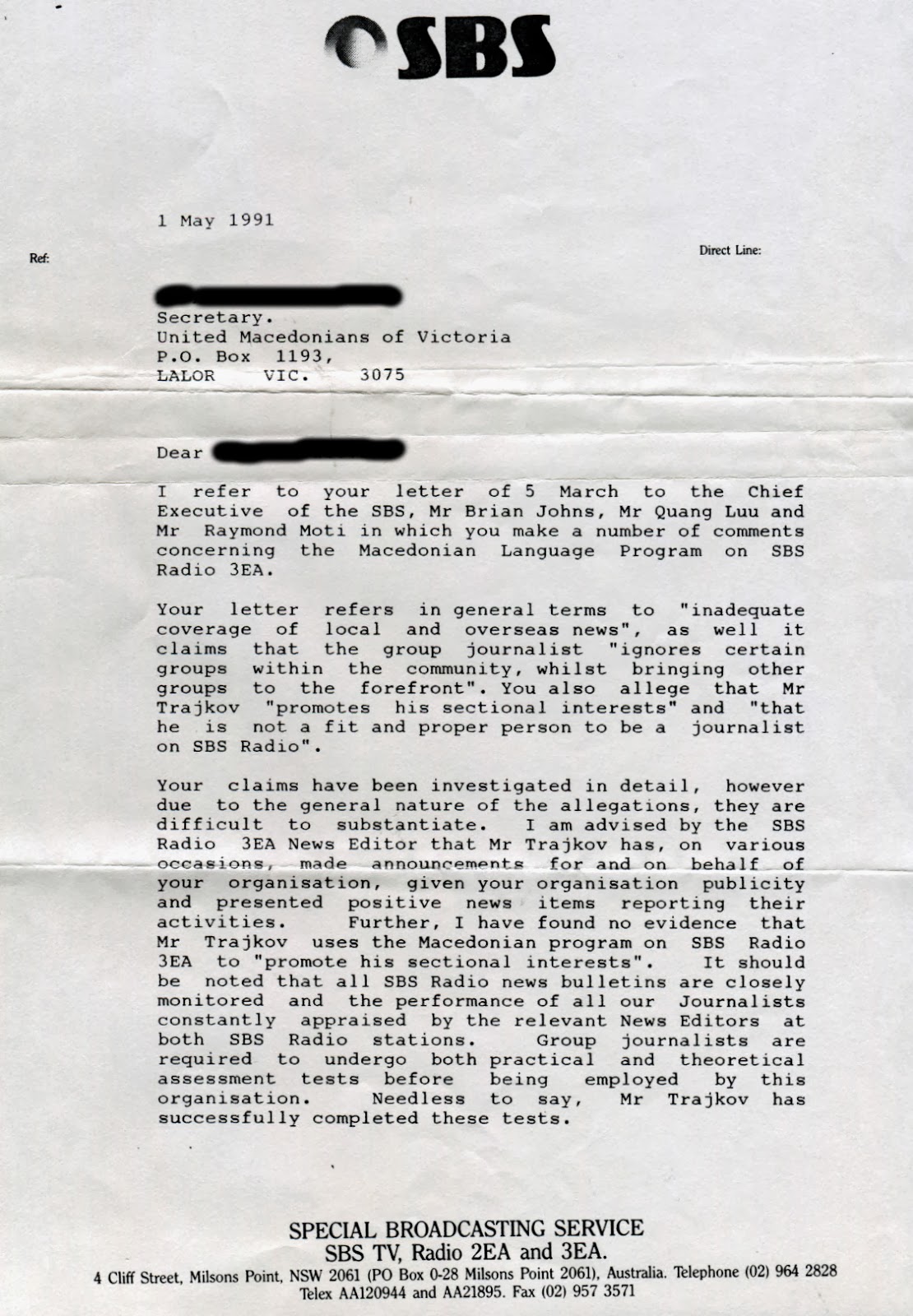
In 1991 an official complaint was lodged by a Macedonian community organisation with SBS Management about Mr Trajkov, but no employee police check was conducted, which is mandatory in the Australian public service.

A previous search with the National Archives of Australia has revealed that the Australian Security Intelligence Organisation (ASIO) opened a file on Mr Trajkov because of his close association with diplomats from the then communist Yugoslavia.

In a previous story, parts which were not published for legal reasons, Mr Trajkov denied he had criminal convictions but claimed he was the victim of "mistaken identity."

Mr Trajkov emigrated to Australia in 1967 from then Yugoslav controlled Macedonia, and opened a cafe/ restaurant in Melbourne.

Victoria Police report of conviction - Boris Trajkov, 1969.


In 1991 The United Macedonians of Victoria organisation wrote to SBS Management and the then Minister for Communications, Kim Beazley, raising concerns about Mr Trajkov's past. 

SBS's investigation included asking Mr Trajkov about his past activities, which he denied. No employee police check, which is mandatory for the Australian Public Service, was conducted. Instead Mr Trajkov threatened to take legal action. However, since 1991 no writ for defamation has been lodged with the Victorian Supreme Court by Mr Trajkov. 

The letter from SBS Management in response to complaints about Mr Trajkov.


PREVIOUS STORY - link 

Monday, December 10, 2012


ASIO MONITORED SBS JOURNALIST


NEWSFLASH

ASIO MONITORED SBS JOURNALIST – BORIS TRAJKOV
By Sasha Uzunov

Australia’s domestic counter-intelligence service monitored a Melbourne SBS Radio journalist before and during his tenure at the multicultural public broadcaster because of his association to Yugoslav diplomats during the 1970s and 80s, newly de-classified files reveal.

The Australian Security Intelligence Organisation (ASIO) opened a file in 1971 on Mr Boris Trajkov who joined SBS Radio (then known as 3EA) in 1975 as a Macedonian language program newsreader and journalist until his departure in 2000 from SBS.

ASIO took an intense interest in Trajkov because of his association with Yugoslav diplomats, including Dr Georgi (George) Trajkovski, the Yugoslav Consul General in Melbourne from 1975-79.


The ASIO file lists Boris Trajkov’s financial affairs, car registration, purchase of house, his business interests in running a restaurant called the Golden Grill, his political activities, and his work at 3EA Radio (SBS). 

ASIO tapped (bugged) telephone conversations as well as conducting surveillance operations and speaking to informants in gathering information on Trajkov. SBS (3EA) Melbourne office switchboard was also monitored by ASIO.

The 66 page file has been placed with the National Archives of Australia and is available for viewing on its website . TEAM UZUNOV applied and was given access to Mr Trajkov's ASIO file after waiting six months. The file covers the period from 1971 to 1983 under the National Archives Act or better known as the 30 year rule.


A sample of the file. 

TEAM UZUNOV will be seeking a response from Mr Trajkov and SBS Management.

Tuesday 11 December 2012
MR TRAJKOV's response: THE CONSUL AND I WERE JUST FRIENDS

Mr Boris Trajkov said that he was not surprised that ASIO was monitoring him because of his high profile within both the Macedonian and Yugoslav communities:

"They were doing their job...That was a normal situation...I was one of the most educated people here in Australia when I arrived."

Mr Trajkov, according to the ASIO files arrived in Australia in 1967 from Macedonia, then part of Socialist Federal Republic of Yugoslavia until its independence in 1991.

Mr Trajkov said that ASIO had tried to recruit him as an inside source or informer but had failed.

"I'm sure that I heard that from inside information that they give up because I was too open."

Mr Trajkov was an officer bearer with the Co-Ordinating Committee of Yugoslav Orgainsations, the Australian Yugoslav Welfare Society, and the Sveti Georgi (Saint George) and Sveti Prorok Ilija (Saint Elijah the Prophet) Macedonian Orthodox Churches in Melbourne.  He was also a Macedonian language broadcaster and journalist with SBS Radio (3EA) in Melbourne from 1975 until his departure in 2000.

Mr Trajkov said he was a politician in Macedonia, then within Communist Yugoslavia before migrating to Australia.

Mr Trajkov dismissed claims of anything sinister over his friendship with then Yugoslav Consul General of Melbourne (1975-79), Dr Georgi Trajkovski (pictured below pointing to Yugoslav map on the wall with Australian Prime Minister Malcolm Fraser in 1979)

Dr Georgi Trajkovski's ASIO file reveals that he had boasted in 1976 of infiltrating the Croatian and Macedonian communities and putting them under Communist Yugoslav control.

Mr Boris Trajkov said they were good friends who went shopping together but never discussed anything that was not appropriate.

"I was friends with Georgi Trajkovski and with other diplomats and Macedonian [post 1991] diplomats and the Macedonian ambassador," he said.

ASIO was interested in Mr Trajkov's restaurant the Golden Grill in Melbourne.

In response, Mr Trajkov said:

"The restaurant wasn't just a Macedonian or Yugoslav restaurant but a restaurant in general...people coming not just different ethnic groups from Yugoslavia but business people, professional people, many singers from the former Yugoslavia and Macedonia... Many diplomats knew me so they would come for dinner."

Mr Trajkov said he was proud of his achievements both in the Macedonian and Yugoslav communities. He was awarded a Medal of the Order of Australia (OAM) for services to the Macedonian community in 1990.

However, opposition to Mr Trajkov developed in the late 1980s over his driving role, with support from Federal ALP Members of Parliament Dr Harry Jenkins Senior and Lewis "Bata" Kent,  in building an Australian-Yugoslav Welfare Society Childcare Centre in Lalor, in the heart of a large Macedonian migrant population, many of whom were ethnic Macedonians from within the modern borders of Greece and felt marginalised or saw it as a way of dividing the community.

A disillusionment with Yugoslavia began to take hold within the Australian-Macedonian community in the late 1980s as Belgrade was seen as not standing up for Macedonian ethnic rights in Greece. In 1991 Yugoslavia disintegrated into the successor states of Federal Republic of Yugoslavia(Serbia-Montenegro), Croatia, Slovenia, Macedonia, Bosnia-Hercegovina and later Kosovo in 1999. The whole region was racked by war for nearly a decade.

In 1988 The Australian Macedonian Weekly newspaper and its editor Jim Thomev campaigned against Mr Trajkov's Yugoslav Childcare Centre in Lalor as this front page shows:


Mr Thomev wrote: "If Mr Trajkov believes that he has the legitimacy to represent the Macedonian people as Yugoslavs let him consult democratically with all the 130 odd organizations in Victoria to test his mandate. Better still he should tried to tell the 5,000 Macedonians who marched on La Trobe [University, in Bundoora, Melbourne] on 5 March this year that they were 'Yugoslav.'"


Balkan passions stirred-- the momentous 1988 Melbourne Macedonian community demonstration at La Trobe University against a Greek academic seminar trying to "prove the Greekness of Macedonia. Originally a rallying cry for human rights for ethnic Macedonians living in Greece it also was a turning point in the community's relationship with Socialist Federal Yugoslavia and its refusal to raise the human rights issue with neighbouring Greece.

At a fairwell cocktail party for Dr Georgi Trajkovski in 1979 after completing his term as Yugoslav Consul General in Melbourne, the then Greek Consul toasted the departing Yugoslav diplomat. The ASIO file includes the guest list.


Friday, October 25, 2013

NED KELLY


1870's colonial Australia, Irish nationalism and Ned Kelly

VICTORIA POLICE FIRING HISTORICAL BLANKS
By Sasha Uzunov

It is a pity to see Victoria Police’s Chief Commissioner Ken Lay and police union boss Greg Davies so ignorant of Australian, British and Irish history. Both have been jumping up and down about how outlaw Ned Kelly and his gang have been elevated to hero status, whilst the three Victorian police constables they shot and killed in 1878 portrayed as victims.

Victoria Police Association Secretary Senior Sergeant Greg Davies, said he was sickened by the constant glorifying of Kelly and his gang. He uses highly emotive words and in an incredible irony accuses people of twisting history.

He even quotes the notorious Winston Churchill, who will become central to this story a lit later. link to Herald Sun story

"Winston Churchill once said that 'history is written by the victors', well, one side of the story around armed robbery, theft and multiple murders committed by a bunch of vicious criminals in country Victoria has certainly challenged that statement," Sen-Sgt Davies said.

"From horse thieving to assaults and armed robberies, to unlawful imprisonment and a plan for a massacre by train derailment, to the murder of three policemen, the real story around Kelly has been twisted to something entirely unrecognisable from the historical truth.

"Those who deliberately distort the truth and try to rewrite history, in order to line their pockets by perpetuating a lie, are the worst thieves of all. They steal our past.”

Perhaps this last bit of advise should apply to Snr-Sgt Davies.

For those who are not familiar with the Ned Kelly (1855-80) story from Australia’s British colonial past. He became a bushranger or outlaw in the colony of Victoria during the late 1800s, and was involved in robbery and killings. Some have elevated him to hero status interpreting, rightly or wrongly, his motives as that of a poor Irishman being picked on by the British authorities at the time.

In 1878 whilst on the run from the law, Kelly shot and killed three Colonial Victorian Policeman: Kennedy, Lonigan and Scanlon, all Irish like Kelly. In 1880 Kelly was executed by hanging Edward ‘Ned” Kelly was the son of an Irish “convict” transported to the then British colony of Victoria as punishment.

Regardless of any crime being committed by Kelly's father, who saw him being transported from his homeland of Ireland by a foreign occupying force, the British Empire to then Colony of Victoria, this act of ethnic cleansing in itself could be interpreted as a "war crime" against the Irish people.

Kelly and his father do not necessarily have to be connected to Irish patriotism or even freedom fighting.

We apply the same standards to a starving Jewish youth taking a loaf of bread for survival in Nazi-occupied Poland and being deported to the killing fields of the Ukraine. Or an apolitical French man, who is was not a member of the French Resistance, involved in smuggling in Nazi occupied France or collaborationist Vichy France (1940-4) trying to survive.

If the apolitical Frenchman, who is not a member of the French Resistance but is a smuggler, then shot and killed three Nazi-collaborationist French policemen, would Snr-Sgt Davies be mourning their loss?

Moreover, the three Victorian Police officers, who were Irish, were committing an act of treason by collaborating with the occupying force. It then becomes irrelevant who pulled the trigger, a bank robber such as Ned Kelly or an Irish freedom fighter and because Ireland was occupied and from time to time there where rebellions which were brutally put down, a semi state of war existed.

The question that historians and journalists need to ask is what were these three doing in serving as collaborators in the Victoria Police? It seems an uncomfortable question to ask.

Furthermore, hasn’t Snr-Segt Davies read about the:

The Irish Rebellion of 1798, a republican uprising against British rule of Ireland
The United Irish Uprising of 1800, an uprising against British rule of Newfoundland
The 1803 Irish rebellion led by Robert Emmet
The Young Irelander Rebellion of 1848, also called The Famine Rebellion of 1848
The Fenian Rising of 1867
The Easter Rising of 1916, a nationalist uprising against British rule of Ireland
The Irish War of Independence (1919–1921).

Snr-Sgt Davies’ “hero’ Winston Churchill was brutal in his opposition to Irish independence.

The Victorian Police officers were, in effect, aiding and abetting the enemy. The colony of Victoria was an extension of Britain. The deaths of the police officers can be attributed to this status of semi-war.

Let me put it to you this way, would Australia have tolerated three Australians serving in the Ottoman Turkish Army at Gallipoli in 1916 fighting against their fellow Australians?

We now have a wonderful country in Australia and a great state in Victoria and people who commit crimes should be punished. But in 1878 and even 1916, Britain was in a brutal manner occupying a foreign land in Ireland, which it finally relinquished in 1922 with the Anglo-Irish Treaty after the Irish War of Independence.

What Snr-Sgt Davies needs to do is study his history and stop “elevating” three Police officers to hero status. 

Furthermore he should apologise to the Republic of Ireland and Australians of Irish decent for his comments.

It would appear that those who uphold the pro-British version of history want to have their cake and eat it too. Sir Roger Casement was in 1916 executed for “treason” for supporting the Easter Uprising and for “collaborating" with the World War One enemy of Britain, Kaiser Germany.

If we follow Snr Sgt Davies logic, then East Timor should not have been allowed to resist or break away from Indonesian occupation--Indonesia invaded the former Portuguese terrirory in 1975.

POST SCRIPT:


My argument is actually legalistic rather than based on nationalist sentiments. The Anglo-Irish Treaty of 1921-22 after the Irish War of Independence is tacit acknowledgment that a state of war existed between Britain & Ireland over the centuries.

If a de facto state of war existed, then Irishmen serving in the British & colonial military and police are collaborators. If they are killed in the line of duty serving a foreign occupier during a state of war then that is not murder. 

As the 3 policemen were chasing or pursuing Kelly he would have every right to shoot them without warning, much in the same way a French civilian during World War 2 were to shoot a French police officer collaborating with Nazi occupation authorities without giving them prior warning; regardless if they a bank robber or a freedom fighter.

 If Ireland had not been granted independence & Ireland had instead been absorbed into the UK then Snr Sgt Davies assertions about the killings would be correct. The Anglo-Irish Treaty in directly "excuses" or "absolves" Kelly of those killings.  

As a journalist I would be asking why did 3 Irishmen collaborate with an occupying force?

If anything, the 3 police officers should be respectfully mourned in the Australia War Memorial as having been killed in defending the British Empire as such; not as law & order martyrs or victims of crime. Australia didn't prosecute the Viet Cong for killing Australian diggers during the Vietnam War (1962-72).


Thursday, October 17, 2013

HELEN OF BE-TROY (BETRAY)?

Helen Clark - Prime Minister (Labour Party) of New Zealand from 1999 to 2008. Now the Chief Administrator of the UNDP since 2009. Photo source: wikipedia/UNDP.

We are still waiting for an answer- 
HELEN OF BE-TROY (BETRAY)?
by Sasha Uzunov


Former New Zealand Prime Minister and now the boss of the United Nations Development Programme (UNDP) Helen Clark was in Sydney, Australia this week to lecture us from her position of “moral superiority” about her new pet project, Sustaining the Rise of the South, but like some who show such courage in doing so, the question is why is Helen Clark so afraid to talk about her contradictory role in being peace activist and war monger?

Clark began as an antiwar activist in the 1960s, especially protesting against the Vietnam War (1962-72).

The Danish Peace Foundation gave her an award in 1986 for her work. But in 2001 as New Zealand’s Prime Minister she sent combat troops into Afghanistan. Even a blind man can see that this a 360 degree turn, a huge contradiction to her long held principles.

Naturally, I wrote to her 5 months ago, 19 May 2013, asking if she would be returning her award as she sent troops to Afghanistan. Her office said she would respond. It's now 5 months later and still no response...

Yet she is able to visit Australia to promote herself as an international do gooder. It would take 5 minutes of her time to respond but she can't find the time, as her staff have said she is busy. Yet she can find time to come to Australia. Remember you the Australian tax payer fund the UN.

Her actions as an anti war activist would have led to many Australian and New Zealand Vietnam veterans to be abused and reviled on their return after completing a tour of duty. Why her dramatic change? Both the New Zealand and Australian public have a right to know.

New Zealand pundit Brian Rudman, writing in the New Zealand Herald, put it:
 “As in the Vietnam War, we're again on the losing side, lured into a war not of our making, by misplaced loyalty to a superpower desperately seeking extra flags to link to its cause.”


Some people would say that Helen Clark as Prime Minister would have to make tough decisions. That’s fine. But with political power comes responsibility. She made the decision, despite being contrary to her confessed anti war principles, but she should return the Danish Peace award. Or if she was willing to protest against Vietnam, she should have resigned as Prime Minister over Afghanistan.

She can’t have her cake and eat it too. We need to call out the do gooders and the politicians, both on the left and right, who “take the high moral ground.”
I learnt long ago that it is not about principle but power for the likes of Helen Clark and her about-face activists or u-turn ideologues

If Joe or Josephine Citizen were to open their mouth on any issue, you can be sure that the elite would hit them over the head with either being fascist or leftist...this is done so the average person can never win... If Helen Clark says its cool to be anti-Vietnam war or any war, then you the average person are pressured into following it. But in 2001 if she decrees that war in Afghanistan is cool... It's called capricious & hypocritical behaviour.

The point with Helen Clark, like many of Australia & New Zealand's cultural elite, both on the left & right wings, is simply a way of showing in an arrogant manner their cultural superiority. It's not the principle...because they change their views, you the average person, are being kept deliberately one step behind them. By the time you come around to their way of thinking, you are already out of date. It's a clever way of keeping control over the "masses" or the great "unwashed." - 

About Face Activists or U-turn ideologues: you just don't know where they really stand and this is deliberate. Others in this group include Lord Robertson, Joschka Fischer, Peter Hain, Mike Rann, and many others.

link to story

Lord Robertson began his career opposed to nuclear weapons but hey that did not stop him from later becoming UK Defence Secretary under British Prime Minister Tony Blair and later NATO Secretary-General.


Joschka Fisher was a militant German leftist who battled against "US imperialism" and in 1973 beat to a pulp a West German Police officer during a violent protest. Later as Germany's Foreign Minister he supported the "US imperialist" war in Afghanistan.


Another ex-British politician Peter Hain in his youth campaigned against apartheid and the Vietnam War but later shouted: "We must not be effete: it's time to fight" in Afghanistan.

According to The Australian newspaper: link:

Born in Britain in 1953, Mike Rann migrated to New Zealand in 1962 with his parents and brother, Christopher. While completing a master of arts in political science at the University of Auckland, he worked as editor of the university newspaper and participated in student politics. He was a member of the New Zealand Greenpeace executive that sent the Greenpeace III to Mururoa Atoll in 1972 to protest against French nuclear testing in the Pacific.

Mr Rann moved to Australia in the mid-1970s and began a career as a politician with the Australian Labor Party (ALP), becoming Premier of South Australia, one of the six states in the Commonwealth of Australia, from 2002 to 2011. As Premier he did an about face and supported uranium mining in his state.

In 2012 he was appointed UK High Commissioner.

Mr Rann was also asked if he felt regret at his actions as a Greenpeace activist in the early 1970s in New Zealand.

Greenpeace was sending boats into French pacific territory with the aim of interrupting nuclear weapons testing. In response the French State Security was provoked into bombing the Rainbow Warrior ship in Auckland Harbour, New Zealand, in 1985. Fernando Perreira, a photographer on board, drowned. Later Mr Rann as Premier of the state of South Australia supported uranium mining. We asked Mr Rann if this ideological about turn meant that the death of Fernando Perreira was in vain. - see link to story

Fernando Perreira - Photographer who drowned when the Greenpeace ship Rainbow Warrior was bombed by French intelligence in 1985.

In Australia the custom is when the actions of military officers, politicians or those who run organisations leads to casualties, it is assumed that those who caused the casualties be held accountable.

Rann, like Clark over Vietnam and Afghanistan, does not want to discuss this period in his life.


THE EMAIL PAPER TRAIL - HELEN CLARK

From: sashauzunov@hotmail.com
To: helen.clark@undp.org; undp-newsroom@undp.org; satinder.bindra@undp.org; abdel-rahman.ghandour@undp.org; christina.lonigro@undp.org; mette.fjalland@undp.org; monica.lorensson@undp.org; trygve.olfarnes@undp.org; sarah.jackson-han@undp.org; adam.rogers@undp.org; rebeca.grynspan@undp.org
Subject: FW: 1986 Danish Peace Foundation award to Helen Clark (UNDP)
Date: Mon, 23 Sep 2013 17:34:49 +1000

Attn Ms Helen Clark
UNDP Administrator
SUBJECT: MEDIA QUERY 

Dear Ms Clark,

It has now been 4 months since I sent you a media query, and no response from you. (19 May 2013)

 On the 7 June 2013 I received a response from your PA acknowledging receipt of my email. You are aware that as a UN Senior Bureaucrat, getting paid Australian taxpayer dollars as well as other countries' contributions, you have an obligation to respond to a question put to you, especially when your job involves in "trying to make the world a better place" and "world peace."

My question was as follows:

Ms Clark, the reason I am writing to you is to ask will you be returning the Danish Peace Foundation Peace Prize you were awarded in 1986? 

As New Zealand Prime Minister (1999-2008) you sent combat troops to the Afghanistan War in contradiction to her long held anti-Vietnam War and overall anti-War principles. During your Prime Ministership you supported military intervention in East Timor and The Solomon Islands.

I look forward to your answer.


Regards

Sasha Uzunov
Independent Film Maker
Melbourne, Australia.
Tel: +61 


My bona fides are available to be viewed at the following links:


From: sashauzunov@hotmail.com
To: helen.clark@undp.org; undp-newsroom@undp.org; satinder.bindra@undp.org; abdel-rahman.ghandour@undp.org; christina.lonigro@undp.org; mette.fjalland@undp.org; monica.lorensson@undp.org; trygve.olfarnes@undp.org; sarah.jackson-han@undp.org; adam.rogers@undp.org; rebeca.grynspan@undp.org
Subject: FW: 1986 Danish Peace Foundation award to Helen Clark (UNDP)
Date: Wed, 24 Jul 2013 13:26:01 +1000

Dear Ms Clark,

It has been just over 2 months since I put in my media query. I am awaiting a response.

cheers
Sasha Uzunov


From: sashauzunov@hotmail.com
To: helen.clark@undp.org; undp-newsroom@undp.org; satinder.bindra@undp.org; abdel-rahman.ghandour@undp.org; christina.lonigro@undp.org; mette.fjalland@undp.org; monica.lorensson@undp.org; trygve.olfarnes@undp.org; sarah.jackson-han@undp.org; adam.rogers@undp.org; rebeca.grynspan@undp.org
Subject: FW: 1986 Danish Peace Foundation award to Helen Clark (UNDP)
Date: Tue, 9 Jul 2013 10:07:44 +1000

Attn Ms Helen Clark,

Dear Ms Clark,

It's been a month since my media query. I'm following up for a response to my questions below.

Cheers
Sasha Uzunov
Independent film maker/journalist
Melbourne, Australia


From: sashauzunov@hotmail.com
To: helen.clark@undp.org; undp-newsroom@undp.org; satinder.bindra@undp.org; abdel-rahman.ghandour@undp.org; christina.lonigro@undp.org; mette.fjalland@undp.org; monica.lorensson@undp.org; trygve.olfarnes@undp.org; sarah.jackson-han@undp.org; adam.rogers@undp.org; rebeca.grynspan@undp.org
Subject: 1986 Danish Peace Foundation award to Helen Clark (UNDP)
Date: Wed, 26 Jun 2013 22:51:50 +1000

Hi Sharon,

Any luck with Ms Clark's response?

cheers
Sasha Uzunov


From: sashauzunov@hotmail.com
To: helen.clark@undp.org
Subject: RE: 1986 Danish Peace Foundation award to Helen Clark (UNDP)
Date: Fri, 14 Jun 2013 09:29:38 +1000

Thank you Sharon.

I look forward to Ms Clark's response.

cheers
Sasha


From: helen.clark@undp.org
To: sashauzunov@hotmail.com
Subject: RE: 1986 Danish Peace Foundation award to Helen Clark (UNDP)
Date: Fri, 7 Jun 2013 21:02:12 +0000

Dear Ms. Uzunov,

This is to acknowledge you email and request below. Ms. Helen Clark is currently travelling on official mission and we will bring your request to her attention upon her return to New York next week.

With best regards,

Sharon Kinsley
Deputy Chief of Staff and Deputy Director
UNDP Executive Office of the Administrator

From: Sasha Uzunov [mailto:sashauzunov@hotmail.com] 
Sent: Monday, June 03, 2013 12:39 AM
To: hdr media; William Orme; UNDP Newsroom; Satinder Bindra; Abdel-Rahman Ghandour; Christina LoNigro; Helen Clark; Mette Fjalland; Monica Lorensson; Trygve Olfarnes; Sarah Jackson-Han; Adam Rogers; Rebeca Grynspan; Carolina Azevedo
Subject: 1986 Danish Peace Foundation award to Helen Clark (UNDP)

Attn UNDP

I'm still waiting on a response from Ms Helen Clark over my query below.

cheers
Sasha Uzunov
Independent film maker and freelance photo journalist
Melbourne, Australia
tel: +61 


For media enquiries, please contact: Carolina Azevedo, +1 212 906 6127,carolina.azevedo@undp.org or William Orme, +1 212 906 6763, william.orme@undp.org; or UNDP Newsroom, +1 212 906 5382, undp–newsroom@undp.org.


Subject: 1986 Danish Peace Foundation award to Helen Clark (ex New Zealand Prime Minister)


Attn Ms Helen Clark
UNDP Administrator

Dear Ms Clark,

My name is Sasha Uzunov, an Australian freelance photo-journalist and independent film maker. 

I'm also a former Australian soldier who served in East Timor. As a civilian cameraman I've worked in Iraq and Afghanistan. 

below are some of my previous stories


My bona fides as a film maker:


Ms Clark, the reason I am writing to you is to ask will you be returning Danish Peace Foundation Peace Prize you were  awarded in 1986? 

As New Zealand Prime Minister (1999-2008) you sent combat troops to the Afghanistan War in contradiction to her long held anti-Vietnam War and overall anti-War principles. During your Prime Ministership you supported military intervention in East Timor and The Solomon Islands.

I look forward to your answer.

Regards

Sasha Uzunov
Tel: +61 
Melbourne, Australia


Wednesday, September 25, 2013

OFFICER INCOMPETENCE IN AFGHANISTAN?


Graphic courtesy of News Limited

OFFICER INCOMPETENCE IN AFGHANISTAN? 

by Sasha Uzunov

The story in the Herald Sun newspaper (see below) raises the ugly possibility that it was Australian Army Officer incompetence that contributed to the deaths of 3 diggers (soldiers) in a green on blue incident, that is Afghan soldiers who are Taliban sleeper operatives attacking Western soldiers.

Ask any former and serving enlisted Australian soldier (myself included), who has never been commissioned as an officer, their opinion of our "leader caste." It would not be too flattering.

Generally speaking, the good officers are the ones who don't buy the subliminal and subtle brainwashing at the Australian Army's Royal Military College - Duntroon about how they are the Lords of the Earth and soldiers are servants, a relic of the 19th century British aristocracy's influence in the armed forces.

Good officers earn the respect of their men by leading by example. Most soldiers accept when officers make tough & unpopular decisions that have a reason...ie. the safety of the unit.

The Australian Army and its parent, the British Army, have a tradition that young officers fresh out of the military academy are mentored by older non-commissioned officers (NCO) or warrant officers (also known as sergeant-majors) who show them the ropes.

Sometimes, the fault can lie with NCO's for not being strong enough in offering their guidance to officers.

We know that democracy does not work in the Army. The Russian Red Army during the Revolution and the Civil War period (1917-20) permitted soldiers to "elect" their commanders and to vote on whether to fight certain battles. It was found to be a disaster. So Leon Trostky, the Red Army Commissar, re-introduced the old system of a hierarchical rank structure. The Red Army went on to win the Civil War.

Good officers in the Australian Army, and there are many, listen to their men and their non-commissioned officers such as corporals and sergeants, but then show their authority by making a decision based on logic.

What is not acceptable is when officers, in order to play the promotion game, are too afraid to think outside the box, don't want to rock the boat. That is because we have a professional careerist officer corps. If they do not do as they are told they receive a poor evaluation report and their career could be destroyed.

I've witnessed how a popular and competent officer had his career destroyed for simply doing his job.

Another point, enlisted soldiers are seen as mere furniture or assets by officers, because soldiers only "make their careers" once they reach the rank of sergeant.

If you have 20 something year olds without any life experiences graduating as officers who are then expected to lead men into battle, you are asking for trouble.

Second point the I thought NATO ran the ISAF mission in Afghanistan, not the United Nations. Perhaps I'm wrong? Read the story below.

LINK
 to story
Herald Sun - September 25, 2013

Army fails Diggers in Afghanistan, finds secret report

A SECRET internal defence report into the murders of three soldiers in Afghanistan by a Taliban "sleeper" has revealed it was incompetence that exposed the three Australian sons to danger - and ultimately cost them their lives.

Lance Corporal Stjepan "Rick'' Milosevic, 40, Sapper James "Marto'' Martin, 21, and Private Robert "Poatey'' Poate, 23 were murdered in cold blood at Patrol Base Wahab on August 29 last year as they played cards.

But the tragedy for the fallen mates - and their families - was that the army failed to provide adequate protection despite increased risks of insider attacks.

A damning internal - and heavily censored - report has revealed the men's commanders knew of increased "green on blue" attacks by Taliban operatives against coalition forces.

The United Nations led coalition - called International Security Assistance Force (ISAF) - ordered security be beefed up.

But the warnings of the spike in insider attacks were never passed to the 22-man platoon.

Taliban operative - Sergeant Hekmatullah - quietly approached their makeshift recreation area.

It was 9.45pm and as the trained killer drew level with two Bushmaster vehicles, where the Aussies were gathered around two tables under a tarp just prior to turning in, he silently switched his weapon to automatic and squeezed the trigger.

Within seconds two bursts of automatic fire had sprayed the Diggers with 23 rounds.

Two died instantly, a third was dying and another two were wounded. In the chaos that followed, the killer had fled.
The report's key findings are;

* A high-level report boosting force protection was released on August 28 but not passed to troops at risk.

* Senior officers failed to adequately address the force protection needs at patrol base Wahab.

* The state of readiness and ability to respond to attack was "inadequate''.

* Senior officers knew that diggers would be unable to secure themselves away from Afghan troops at Wahab.

* No Australian intelligence existed about the risk from Hekmatullah.

The Taskforce Commander, a Lieutenant Colonel, and the Lieutenant in command of the platoon were both promoted months before the report was finalised.

The triple murder occurred just 13 days after a warning about increased "sleeper'' attacks from Taliban chief Mullah Omar and during a spike in so called "green on blue'' insider attacks by Afghan soldiers.


Tuesday, September 17, 2013

THE MIJALKOV HIT?


THE JORDAN MIJALKOV HIT - was the Macedonian Minister assassinated?

by Sasha Uzunov

Just before Christmas 1991, I got a phone call from two Melbourne based branch members, Andon Lazarevski and Vidan Zvezdakovski, from VMRO-DPMNE, now the governing party in Macedonia. They were faxing media releases about the unexpected death of Jordan Mijalkov, Macedonia's Interior Minister. One was sent to the BBC in London but with no response.

They asked if I, as an independent freelance journalist, was interested in the story? I said I was happy to talk to anyone from any political party, including Macedonia's Social Democrats (SDSM), or ethnic background for information. It is a hard business trying to steer an independent course amongst Macedonia's two major political parties.

In December 1991 Jordan Mijalkov, was killed in a car accident as he was rushing to meet with his Serbian counterpart. At the time there was speculation his death had been arranged by person or persons unknown. The other possibility was it was a genuine car crash. Link to story

A later story in the British magazine The Economist in 2011 had this to say on Mijalkov:

"Mr Mijalkov's memory is cherished by many. It was he who ordered the seizure of Yugoslav army documents, which meant that the army could not mobilise Macedonians to fight in Croatia. Soon afterwards, he was killed in a suspicious car accident in Serbia."

In 1991-92 I did some digging but could not find any further information and left it at that. However, in 1993 during my stay in Macedonia as a correspondent with the MILS news agency I was invited to dinner by a prominent Macedonian journalist in Skopje.

We devoured the tavche gravche (baked beans and meatballs) and then hit the dessert cakes and cleansed our palette with the customary Turkish coffee afterward. Then we got onto the subject of Jordan Mijalkov. To be honest  I don't remember how we got onto the subject

Without any prompting, the journalist got up from the kitchen table, walked to a set of cabinet drawers and pulled out a map. It was hand drawn in black pen, detailing where exactly Mijalkov's car had crashed in Serbia, near the town of Vranje. He was adamant that it was driver error that caused the death. I kept an open mind. To this day I still don't know what to think.

What aroused my curiosity was the fact that the journalist had this map at the ready in his kitchen to show "foreign" journalists. I told a North American colleague about the story of the map, and he too had his curiousity aroused.

Jordan Mijalkov is the uncle of Macedonia's current Prime Minister Nikola Gruevski. Mijalkov's son and Gruevski's cousin, Saso, is Macedonia's Intelligence Chief. PM Gruevski and the Mijalkov's family have never bought the official version of the death.

A later story in the British magazine The Economist in 2011 had this to say about Gruevski:

"MACEDONIANS either love him or loathe him. To his detractors, Nikola Gruevski, who was confirmed as prime minister for a third term on July 28th, is corrupt, a populist, a ruthless Machiavellian and an enemy of a free media. “No, no, no,” say his supporters. He is as clean as a whistle, modest, the scourge of tax-dodging tycoons and a family-values man to his core.

Spy mania and conspiracy theories have always been popular past times in the Balkans region of Europe. It seems history has a tendency to repeat itself. A new spy mania has spread through Macedonia.

Without passing judgment, I am a firmer believer in innocent until proven guilty, days ago a number of high profile arrests have been made in connection to people allegedly working for foreign governments. We await the investigation, where the accused can through a proper and fair legal process either clear their names or the government can prove its case. Link to story


Sunday, September 15, 2013

STAMP SCANDAL - NAZI COLLABORATOR


STAMP SCANDAL - NAZI COLLABORATOR 
- Where is the European Union, where is Stefan Fule? 
- Where is NATO? WHERE IS LORD ROBERTSON? JAVIER SOLANA?

by Sasha Uzunov 

To appease ethnic Albanian nationalist sentiment within the country, the Republic of Macedonia's Post Office is about to issue a stamp commemorating Rexhep Mitrovica, a staunch Albanian nationalist, (1887 - 1967) who was the Prime Minister of Albania's government under Nazi Germany from 1943 to 1944.

The link
to the Macedonian Post Office website offering the controversial stamp.

However, in a conflicting report in the Macedonian media, the Ministry for Transport and Communications, which overseas the Post Office, has said it does not support the stamp but the responsibility lies with the Post Office. Link to story is here. 


"On 6 November 1943, Berlin announced that a Pro-Nazi Germany Albanian government headed by Rexhep Mitrovica, an active member of the Balli Kombëtar from Kosovo, was formed. Mitrovica's cabinet, most of whom had credentials as nationalists as well as some German or Austrian connections." Link to source material

The Republic of Macedonia consists of about 70% ethnic Macedonians, and about 20 to 25% ethnic Albanians. Under pressure from NATO and the West, Albanian nationalist groups under Ali Ahmeti and his DUI party have pushed out other ethnic Albanian parties to share power in Macedonia's coalition government with, strangely and paradoxically, is VMRO-DPMNE, a Macedonian nationalist party. 


Lord Robertson shakes hands with Ali Ahmeti

During a short lived war in Macedonia in 2001, launched by Ali Ahmeti, Ahmeti's National Liberation Army fought the then Macedonian coalition government consisting of VMRO-DPMNE and DPA (Democratic Party of Albanians). Under pressure from NATO's Lord Robertson and the European Union's Javier Solana, Ahmeti was given a share of political power in Macedonia.

During World War 2, Macedonian Partizans fought Nazi Germany, Fascist Italy and Bulgaria and the Balli Kombetar (Albanian Balists) from 1941 to 1945.


The Bulgarian occupying forces were responsible for wiping out Macedonia's Jewish population.

Questions remain as to why such a stamp was authorised, considering Mitrovica's well documented links to Nazi Germany? And what action the current Macedonian coalition government and European Union Commissar and Balkan envoy Stefan Fule will take?


Photo (above): World War II - Macedonian Partizan units marching through the Macedonian town of Bitola in 1944. Some of these units in the Bitola-Prilep-Prespa-Aegean Macedonia regions fought some of the toughest and nastiest battles against Nazi Germany (1941-45), Axis allies Bulgaria (1941-44) and Fascist Italy (1941-43) and the Balli Kombetar (Albanian nationalists aligned with Nazi Germany).

Saturday, September 14, 2013

STEVE JOBS OF APPLE & SKOPJE CITY !


Steve Jobs - photo credit: Matthew Yohe - Wikipedia


COULD STEVE JOBS OF APPLE COMPUTERS HAVE SUCCEEDED IN CITY OF SKOPJE?
By Sasha Uzunov

The legacy of one of the greatest geniuses the world has ever known, the late Steve Jobs, is that we have hi-tech mobile phones and computers that have allowed the average person to become a reporter of world events. This legacy together with the advent of social media has brought dramatic global political changes. But the question I would like to pose is could Steve Jobs have succeeded in Skopje, the capital city of the Republic of Macedonia?

THE ANSWER IS NO

The answer is a very obvious NO. Putting aside the lack of economic incentive, from a cultural perspective Steve Jobs would never have been able to do anything. So hypothetically if by some miracle the European Union or some other body was to pour a bag of gold or a fistful of dollars into Macedonia…there would still be no Steve Jobs.

WHY?

Firstly, Steve Jobs dropped out of university in his homeland of the United States. In status conscious Macedonia, run by the over-credentialed, City of Skopje cultural elite, Steve Jobs would have suffered ridicule for being an “uncultured peasant (nekulturen selanec).”

Secondly, Steve Jobs was not the off-spring of Macedonia’s former communist ruling elite, and in post-communist Macedonia, not belonging to any of the major political parties, he would never have been able to open his mouth, let alone create or invent anything.

Thirdly, in order to conform to the City of Skopje ruling and cultural elite and in order to “belong socially” he would have had to spent most of his time hanging out in cafes (kafic or kafani) chain-smoking and listening to Bijelo Dugme or Ceca of Serbian Turbo-folk music fame, and indulging in conspiracy theories and blaming everyone, including the government, the state, the CIA, the Vatican, the KGB, aliens etc for his predicament.

An example of Macedonian style nanny statism is Ana Stojanov(a) who did a Master's degree at Cambridge University, Britain, in child psychology and then returned to her homeland of Macedonia complaining about not being given a chance, that is a comfy public service job in an office!

Link to The Nanny State - Macedonian style article

But we know that Steve Jobs spent a lot of his time doing “uncool things” like tinkering in his parents’ garage trying to invent a computer. The City of Skopje elite would have perceived him as being crazy, even though many of them use his products, I-phones and Apple computers.

Fourthly, and this ties in with the previous point: Steve Jobs would have been punished by the City of Skopje cultural elite enforcers for being curious, for asking questions, for taking things apart and simply trying something different. He would have been hit over the head with “pravopis,” the obsession with speaking correct and formal Macedonian even though the elite itself does not practice what it preaches.